
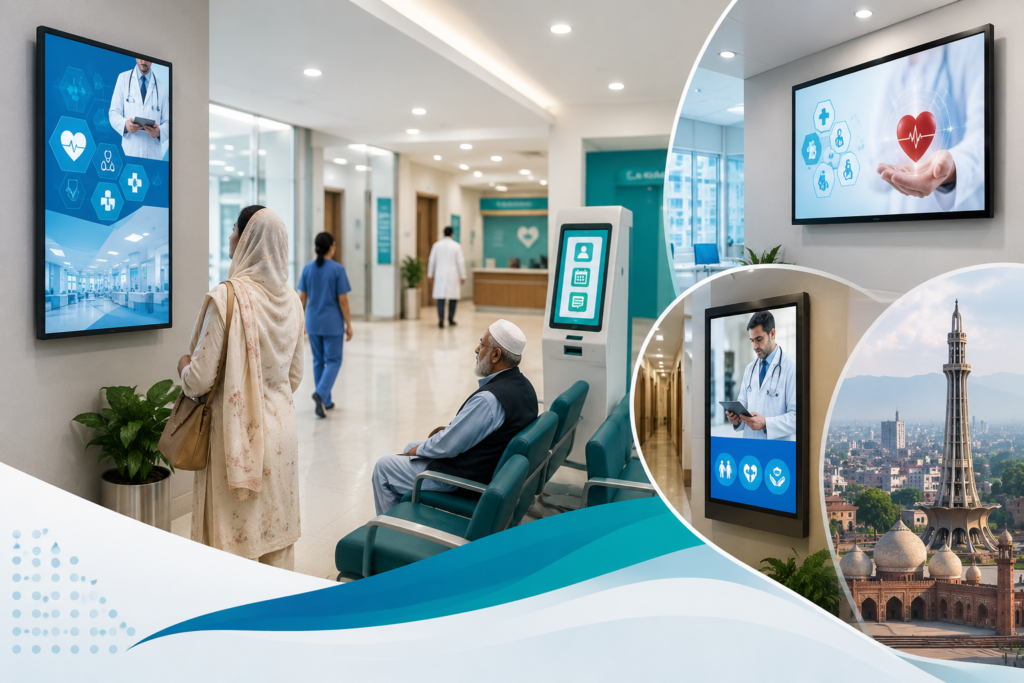
| TL;DR — Quick Answer
A digital signage solution for hospitals and clinics in Pakistan typically covers wayfinding displays, queue and token management screens, waiting room health information, and staff communication boards, replacing printed signs and manual announcements with real-time, centrally updated content. Healthcare environments need displays built for continuous daily operation, easy-to-clean surfaces, and reliable brightness under mixed lighting conditions, rather than consumer-grade screens borrowed from retail use. Smart One Technologies designs and installs digital signage solutions for healthcare facilities across Pakistan, matching display type, placement, and content management to each facility’s actual patient flow and departmental layout. |
Walk into almost any busy hospital or clinic in Pakistan and the same scene plays out: crowded waiting areas, patients unsure which counter to approach, printed notices taped to walls that were outdated weeks ago. A well-planned digital signage solution addresses all of this at once — replacing static, easily outdated signage with centrally managed screens that guide patients, display real-time queue information, and communicate updates instantly across an entire facility. As healthcare providers across Pakistan look to modernize the patient experience without overhauling their entire infrastructure, digital signage has become one of the more practical, high-impact upgrades available.
This guide covers where a digital signage solution makes the biggest difference in a hospital or clinic setting, what technical factors matter most in a healthcare environment specifically, and how to plan an installation that actually improves day-to-day operations rather than just looking modern.
It’s worth noting upfront that healthcare signage isn’t simply retail digital signage relocated to a hospital corridor — the operating conditions, reliability expectations, and content needs are different enough that treating it as its own category, with its own planning process, consistently produces better results.
Why Hospitals and Clinics in Pakistan Are Adopting Digital Signage
Healthcare facilities face a communication challenge that most other industries don’t: information needs to reach anxious, often unwell people quickly and clearly, while also keeping staff coordinated across multiple departments. A digital signage solution solves both sides of this problem simultaneously. For patients, it reduces confusion around wayfinding and queue status. For staff, it centralizes announcements, department updates, and safety information that would otherwise depend on printed notices or word of mouth. As private hospitals and specialist clinics across cities like Lahore, Karachi, and Faisalabad compete on patient experience alongside clinical quality, digital signage has increasingly become part of that competitive differentiation.
Key Applications of a Digital Signage Solution in Healthcare Settings
Wayfinding and Directional Displays
Large hospital buildings with multiple floors and departments are genuinely difficult to navigate, particularly for a first-time patient who may already be anxious. Corridor and lobby displays showing clear directional information reduce both patient stress and the time staff spend answering repeated directional questions, while also accommodating changes when a department temporarily relocates or a service moves to a different floor.
Queue and Token Management
Digital queue displays linked to a token management system show real-time counter assignments and estimated wait times on screens throughout the waiting area, replacing manual token calling with a clear, visible, and less chaotic process that also reduces the perceived uncertainty of an open-ended wait.
Waiting Room Health Information
Waiting areas are a natural opportunity to display general health awareness content, department information, or service announcements, turning otherwise unused waiting time into a chance to inform patients rather than leaving them staring at a blank wall.
Staff Communication Boards
Break rooms, nursing stations, and staff corridors benefit from dedicated displays showing shift schedules, internal announcements, and operational updates, reducing reliance on printed memos that are easy to miss or ignore.
Emergency and Safety Alerts
A properly integrated digital signage solution can push urgent safety announcements across every connected screen in a facility simultaneously, a meaningful advantage over printed notices during time-sensitive situations.
Technical Considerations for a Healthcare Digital Signage Solution
| Consideration | Why It Matters in Healthcare Settings |
| Continuous daily operation | Hospital displays often run 12–24 hours a day, requiring hardware built for sustained use, not intermittent retail-style operation |
| Easy-to-clean surfaces | Displays in clinical or high-touch areas need surfaces that tolerate regular disinfection without damage |
| Brightness for mixed lighting | Hospital corridors and waiting rooms often combine natural light, fluorescent lighting, and shadowed areas within the same space |
| Reliable uptime | A blank or frozen screen showing queue information creates confusion rather than solving it, making system stability a priority |
| Centralized content management | Facilities with multiple departments need to update content from one place rather than adjusting each screen manually |
These requirements are why a digital signage solution built for retail advertising doesn’t automatically translate well to a healthcare setting — the display technology may be similar, but the operating conditions and reliability expectations are meaningfully different.
Choosing the Right Display Type for Your Facility
- Indoor SMD/LED displays: Well suited to lobby areas and large corridors needing bright, high-visibility content across a wide viewing angle.
- Standard commercial displays: Practical for individual department signage, queue boards, and smaller waiting areas where a full video wall isn’t necessary.
- Digital standees: Useful for entrance areas and reception desks, offering a compact, freestanding display for wayfinding or general announcements.
- Video walls: Suited to larger main lobbies in bigger hospitals, where a single large-format display serves as a central information point visible from multiple directions.
Why Choose Smart One Technologies for Healthcare Digital Signage
Implementing a digital signage solution in a healthcare facility requires more than supplying screens — it requires understanding patient flow, department layout, and the durability demands of continuous clinical operation. Smart One Technologies, operating in Pakistan since 2005, brings its broader indoor and outdoor SMD screen and display installation experience to healthcare projects, assessing each facility’s actual layout before recommending display types and placement, rather than applying a generic retail signage package to a clinical environment.
Buyers can review completed display projects on the Our Projects page, learn more about the company’s background on the About page, or reach out through the Contact page to discuss a healthcare signage project.
How a Digital Signage Solution Improves Staff Efficiency
While patient experience tends to get most of the attention, a digital signage solution also has a measurable effect on how staff spend their time. Reception and front-desk staff in facilities without proper wayfinding often field the same directional questions dozens of times a day, time that could otherwise go toward actual patient coordination. Centralized digital signage reduces this repetitive burden by putting clear, consistent directional and status information directly in front of patients before they need to ask.
Internal staff displays offer a similar benefit on the operational side — shift changes, department announcements, and policy updates can reach everyone on duty simultaneously, rather than depending on a printed notice board that not everyone checks or a message passed verbally between shifts that can get lost in translation.
Digital Signage for Patient Education and Service Promotion
Beyond wayfinding and queue management, a digital signage solution gives hospitals and clinics a practical channel for patient education content — general health awareness material, preventive care reminders, or information about specific services and specialist departments available on-site. Unlike a printed pamphlet that a patient may or may not pick up, screen-based content plays passively in front of a captive waiting room audience, making it a more reliable way to communicate this kind of information at scale.
This same infrastructure can also support service promotion for private clinics and hospitals competing on patient experience, highlighting specialist departments, new equipment, or extended hours without needing to reprint physical materials every time something changes.
Planning a Digital Signage Rollout Without Disrupting Operations
A common concern hospital administrators raise is how to install a digital signage solution without disrupting an active facility. In practice, this is managed by phasing installation department by department, scheduling mounting and cabling work during lower-traffic hours, and testing each display fully before it goes live to patients. Facilities considering a full rollout often start with the highest-impact areas — main entrance wayfinding and the primary waiting room — before expanding to individual department signage over subsequent phases.
Maintenance and Long-Term Reliability
Healthcare facilities can’t afford extended downtime on a digital signage solution that patients and staff rely on daily. A proper support arrangement should include scheduled hardware checks, prompt response for any display failures, and content management support to keep information current across every connected screen. Smart One Technologies provides installation and after-sales support for its healthcare display projects, helping facilities avoid the disruption of a queue board or wayfinding screen going dark during business hours.
Frequently Asked Questions
What is a digital signage solution used for in a hospital?
A digital signage solution in a hospital typically covers wayfinding, queue and token management, waiting room information, staff communication, and emergency alerts, all managed centrally rather than through printed signs and manual announcements.
Do hospital digital signage displays need special hardware?
Yes. Healthcare displays generally need to support continuous daily operation, tolerate regular cleaning and disinfection, and remain readable under mixed lighting conditions, which differs from typical retail-grade display requirements.
Can a digital signage solution integrate with a hospital’s queue management system?
Yes. Queue and token management software can be connected directly to lobby and waiting room displays, allowing real-time counter assignments and wait times to update automatically without manual intervention.
How long does it take to install digital signage across a hospital?
This depends on facility size, but installations are typically phased department by department to avoid disrupting active clinical operations, often starting with entrance wayfinding and the main waiting area before expanding further.
What happens if a hospital digital signage display fails?
A proper support agreement should include prompt response for hardware failures, since a blank or frozen queue or wayfinding screen can create confusion rather than solve it during business hours.
Can digital signage help promote hospital services alongside wayfinding?
Yes. The same displays used for wayfinding and queue management can rotate in patient education content or service promotion during idle periods, giving facilities a flexible communication channel beyond just directional information.
Final Thoughts
A well-planned digital signage solution does more than modernize a hospital or clinic’s appearance — it directly reduces patient confusion, streamlines queue management, and keeps staff better informed across departments. Getting the display type, placement, and reliability requirements right for a clinical environment, rather than adapting a generic retail signage package, is what determines whether the investment genuinely improves day-to-day operations or simply adds another screen to the wall.
As competition among private hospitals and specialist clinics across Pakistan continues to grow, patient experience has become a genuine differentiator alongside clinical quality — and a properly implemented digital signage solution is one of the more practical, visible ways a facility can demonstrate that investment to every patient who walks through its doors.
| Planning a Digital Signage Rollout for Your Facility?
Smart One Technologies designs and installs digital signage solutions for hospitals and clinics across Pakistan. Get a free consultation and quote today. 📞 +92 321 408 6763 | ✉ sales@sot.com.pk | www.sot.com.pk |

0 Comments on “Digital Signage Solutions for Hospitals and Clinics in Pakistan”