
| TL;DR — Quick Answer
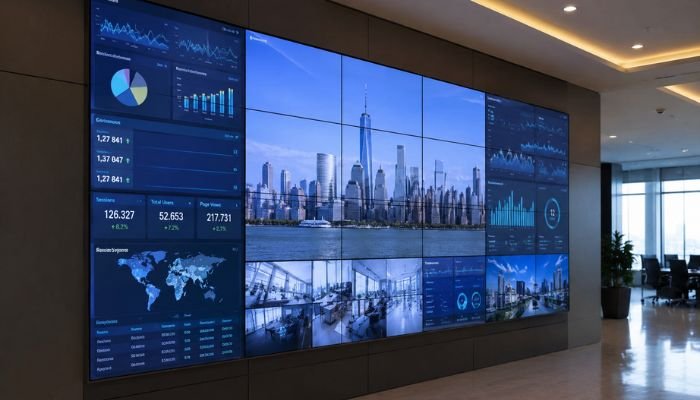
A video wall is a large display surface built from multiple LED or LCD screens tiled together to act as one seamless image. The number of screens you need depends on three things: the physical size of the wall, your average viewing distance, and the pixel pitch of the panels you choose. Most commercial spaces in Pakistan use configurations between a 2×2 grid (4 panels) for small huddle rooms and a 4×4 grid (16 panels) or larger for retail facades, control rooms, and stadium boards. Smart One Technologies (sot.com.pk) helps businesses calculate the exact panel count, pixel pitch, and layout before installation, so you never overpay for resolution you can’t see or underbuy for a wall that looks pixelated up close. |
If you’ve ever walked into a mall, an airport lounge, or a corporate lobby in Lahore, Karachi, or Islamabad and stopped to stare at a giant, glowing wall of visuals stitched together like one impossibly sharp screen, you’ve already met a video wall. But behind that single seamless image is a web of decisions — panel count, pixel pitch, viewing distance, aspect ratio, and processing power — that most people never think about until they’re the ones buying one.
This guide breaks down exactly what a video wall is, how the technology behind it actually works, and — the question almost every buyer eventually asks — how many screens you genuinely need for your space. We’ll also walk through real configurations used across retail, corporate, control room, and event environments in Pakistan, so you can walk into a project brief with numbers that actually make sense.
What Is a Video Wall?
A video wall is a large-format display made by tiling multiple individual screens — either LED modules or LCD panels — into a single grid that a video wall processor treats as one continuous canvas. Instead of showing four, six, or sixteen separate pictures, the controller stretches one image, video, or live feed across every panel so the seams disappear and the audience sees a single, unified display.
The term covers a broad family of setups: a small 2×2 LCD video wall in a meeting room, a curved LED video wall wrapping around a retail storefront, or a massive fine-pixel-pitch LED display used as a stadium scoreboard or command-and-control backdrop. What ties them together isn’t size — it’s the tiling architecture and the software layer that makes many screens behave like one.
LED Video Walls vs LCD Video Walls
- LED video walls: built from LED display modules with no visible frame, ideal for large seamless surfaces, digital signage, and both indoor and outdoor advertising. Pixel pitch (the distance between individual LEDs) determines how close viewers can stand before the image looks grainy.
- LCD video walls: built from ultra-narrow-bezel LCD panels, more cost-effective for smaller indoor installations like control rooms or lobby displays, though a faint bezel line remains visible between panels.
For most retail, corporate, and outdoor advertising projects across Pakistan, LED remains the preferred route because it scales to almost any size and shape without the bezel interruption that LCD panels carry.
How a Video Wall Actually Works
Three components make a video wall function as a single display rather than a stack of separate monitors:
- Display panels — the individual LED modules or LCD tiles that make up the physical grid.
- Video wall processor / controller — hardware or software that splits a single source (a presentation, a live camera feed, a media player) across every panel in perfect alignment.
- Content management system — the software layer that schedules, updates, and pushes content remotely, especially important for digital signage networks running across multiple branches or cities.
Get any one of these wrong — an underpowered processor, mismatched pixel pitch, or a content system that can’t handle your resolution — and the “seamless” video wall starts to look like exactly what it is: several screens awkwardly guessing at one picture.
How Many Screens Do You Really Need?
This is the question that determines your entire budget, so let’s answer it properly instead of guessing. The right screen count for a video wall comes down to four variables working together, not one number pulled from a catalog.
1. Physical Wall Size
Measure the available width and height in feet or meters first. A video wall calculator (or your installer) then divides that space by the size of a single panel to get your grid — for example, a 12ft x 7ft wall using 55-inch LCD panels typically lands around a 4×2 or 5×3 configuration, while the same space in LED modules is quoted in individual tiles rather than diagonal screen size.
2. Viewing Distance
Viewing distance decides the pixel pitch you can get away with, and pixel pitch decides how many LED modules you’ll need to fill the same area at acceptable clarity. As a rough industry rule:
- Under 3 feet (close-up, retail counters, reception desks): fine pixel pitch, P1.2–P1.8
- 3–10 feet (meeting rooms, lobbies, control rooms): P1.8–P2.5
- 10–30 feet (retail floors, showrooms, auditoriums): P2.5–P4
- 30+ feet (stadiums, outdoor billboards, large event stages): P4–P10 or higher
A tighter pixel pitch means smaller LED modules and, in turn, more individual units packed into the same wall — which is why two video walls of identical physical size can have completely different screen counts and price tags.
3. Aspect Ratio and Content Type
A control room monitoring dozens of live camera feeds needs a wide, tiled matrix (think 5×4 or 6×3) so operators can dedicate individual quadrants to individual sources. A retail brand wall showcasing a single hero video, by contrast, often works better as a clean 3×3 or 4×4 square block that reads as one strong visual statement rather than a grid of data.
4. Budget and Scalability
Because LED video walls are modular, you can start with a smaller grid — say 3×3 — and physically expand it later as budget allows, provided the same panel series and pixel pitch are still available. This is one of the biggest practical advantages LED holds over fixed LCD video walls, which are far harder to scale once installed.
Common Video Wall Configurations at a Glance
- 2×2 (4 panels): huddle rooms, small reception areas, boardrooms
- 3×3 (9 panels): mid-size lobbies, showroom displays, restaurant menu boards
- 4×4 (16 panels): retail storefronts, bank branches, hotel lobbies
- 5×3 or 6×4 (15–24 panels): control rooms, network operation centers, transit hubs
- Custom / non-rectangular grids: stadium fascia boards, curved building facades, stage backdrops for events and weddings
Video Wall Use Cases Across Industries
The same underlying technology adapts to very different jobs depending on the industry:
- Retail & shopping malls: eye-catching digital signage that rotates promotions, new arrivals, and brand storytelling across storefronts in Lahore, Karachi, and Rawalpindi.
- Corporate offices: reception branding walls, boardroom presentation screens, and real-time dashboards for KPIs.
- Control rooms & security operations: multi-feed CCTV monitoring walls for utilities, traffic management, and facility security across major Pakistani cities.
- Events & weddings: rental LED video walls used as stage backdrops, giving planners a flexible, high-impact visual centerpiece for a single evening.
- Education & auditoriums: large lecture-hall displays and interactive smart board integrations for hybrid learning.
- Sports & stadiums: fine pixel pitch scoreboards and perimeter advertising boards visible from every seat, including venues built for cricket stadiums across the country.
Pixel Pitch, Resolution, and Screen Count: How They’re Connected
It helps to think of pixel pitch as the zoom level of your video wall. A smaller pitch packs more LEDs — and therefore more individual modules — into the same physical area, which pushes both resolution and cost upward. A larger pitch needs fewer, larger modules to cover the same wall, which is exactly why outdoor billboards viewed from fifty meters away don’t need anywhere near the density of an indoor boardroom screen viewed from six feet.
When Smart One Technologies scopes a video wall project, pixel pitch and panel count are calculated together against the confirmed viewing distance — never chosen independently — because a beautiful pixel pitch spec means nothing if the panel count doesn’t match the physical wall dimensions available on site.
Cost Considerations Before You Buy
Video wall pricing scales with three factors, roughly in this order of impact:
- Total panel/module count — more screens means more hardware, more cabling, and more processing power required.
- Pixel pitch — finer pitch (smaller pixel spacing) costs meaningfully more per square foot than a coarser, budget-friendly pitch.
- Installation complexity — curved walls, ceiling-suspended rigs, and outdoor weatherproof enclosures all add labor and structural cost beyond the panels themselves.
A practical way to control cost without compromising the visual outcome is to right-size the pixel pitch to the actual viewing distance rather than defaulting to the finest pitch available — a common overspend Smart One Technologies flags during almost every consultation.
Why Businesses in Pakistan Choose Smart One Technologies
Smart One Technologies (sot.com.pk) works with authorized LED and display brands including Qiangli, Dahua, Hikvision, Unilumin, Absen, and LianTronics to design, supply, and install video walls sized correctly for the space they’re going into — not oversold on panels a client doesn’t need. From the initial site measurement and viewing-distance assessment to pixel pitch selection, processor configuration, and after-sales maintenance, the team handles the full lifecycle of a video wall project.
Whether the requirement is a compact 2×2 boardroom display, a full retail facade in a busy Lahore shopping district, or a multi-feed control room wall for a security operations center, Smart One Technologies and its sister platform, smdscreens.com.pk, provide sourcing, technical consultation, and on-site installation support across Lahore, Karachi, Islamabad, Rawalpindi, Faisalabad, and Multan.
Installation and Maintenance Tips
- Confirm structural load capacity before mounting large LED video walls — panel weight adds up fast across a wide grid.
- Keep a service gap or hinge-open access on LED cabinets for module-level repairs without dismantling the whole wall.
- Schedule routine cleaning and brightness calibration, especially for outdoor displays exposed to dust and direct sunlight.
- Use a dedicated content management system for multi-branch signage networks so updates can be pushed remotely instead of on-site.
Frequently Asked Questions
What is the difference between a video wall and a regular large TV?
A single large TV is one physical panel with a fixed maximum size. A video wall combines multiple smaller panels or LED modules into a grid, which lets it scale to almost any size, shape, or curve that a single television never could.
How many LED panels do I need for a small office video wall?
Most small office or boardroom video walls use a 2×2 configuration, roughly four LCD panels or a compact LED module grid, which comfortably covers presentation and video-conferencing needs at typical seating distances.
Is LED or LCD better for a video wall?
LED is generally better for larger, seamless, or outdoor-facing video walls because it has no visible bezel and scales freely. LCD is often more budget-friendly for smaller, purely indoor installations like control rooms.
Can a video wall be expanded after installation?
Yes, LED video walls are modular by design, so additional panels can usually be added later as long as the same panel series and pixel pitch remain available from the original supplier.
What pixel pitch should I choose for a retail storefront?
For storefronts typically viewed from 10 to 30 feet away, a pixel pitch in the P2.5 to P4 range balances image clarity with cost, though closer viewing distances call for a finer pitch.
Final Thoughts
A video wall isn’t a single product you buy off a shelf — it’s a system of screens, processing, and planning that has to match the room it’s going into. Get the panel count and pixel pitch right for your actual viewing distance, and the wall disappears into pure image; get it wrong, and viewers see nothing but seams and grain.
If you’re planning a video wall installation anywhere in Pakistan, Smart One Technologies (sot.com.pk) can walk through the site measurements, viewing distance, and budget with you before recommending a single panel — so the configuration you install is the one your space actually needs.

0 Comments on “What Is a Video Wall & How Many Screens Do You Really Need?”