
| Quick Answer
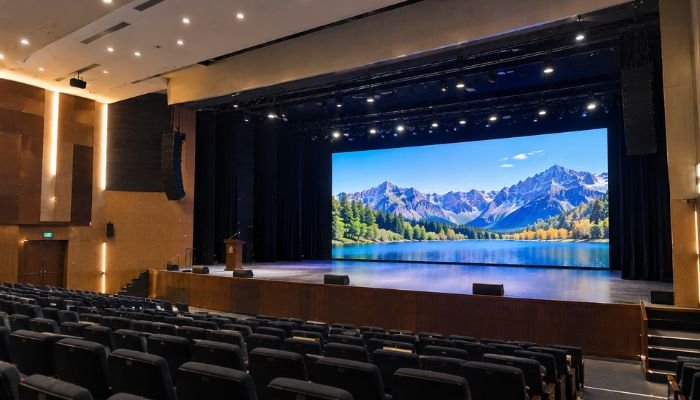
Auditorium LED video walls in Pakistan require fine-pitch high-definition displays (P1.8 to P2.5) that deliver seamless 4K visual clarity without interfering with hall acoustics. Smart One Technologies engineers large-format stage displays featuring whisper-quiet fanless cooling (<20dB), wide 160° viewing angles, and Novastar ultra-low latency processing for corporate auditoriums, universities, and convention centers across Pakistan. |
If you’re planning an LED video wall for an auditorium, conference hall, or university seminar room in Pakistan — this guide is for you. We’ll walk you through everything: the right screen size, pixel pitch, how to make sure the display doesn’t interfere with your sound system, and what actually drives the price.
Smart One Technologies has installed auditorium LED screens across Pakistan — in Lahore, Karachi, and Islamabad — for corporate offices, universities, and convention centers. Here’s what we’ve learned.
Why an Auditorium Screen Is Different From Any Other LED Display
Most people assume an LED video wall is just a bigger TV. In an auditorium, that thinking causes problems.
You have people sitting 3 meters from the screen and people sitting 30 meters away — all watching the same display at the same time. You have live microphones that pick up fan noise. You have stage lighting that creates glare. And you have presentations, live camera feeds, and video all running on one canvas.
Here’s what makes auditoriums uniquely challenging:
- Front and back rows both matter. The pixel pitch has to look sharp up close, while the screen size has to stay readable from the back.
- Sound comes first. A screen that hums or whirs is a problem when microphones are live on stage.
- Stage lighting causes glare. Glossy screen surfaces reflect spotlights directly into the audience’s eyes.
- Content varies. Slides, video, live camera, branded graphics — all need to look good on the same wall.
Auditorium Display Engineering Matrix
Use this as your starting point. These are the specs we recommend based on hall size:
| Auditorium Capacity | Pixel Pitch | Display Dimensions | Acoustic & Noise |
| Small Hall
(100–300 Seats) |
P1.5 to P1.8
Fine Pitch |
12ft × 7ft
(Native 1080p Full HD) |
100% Fanless Convection
(Zero mic hum) |
| Medium Auditorium
(300–700 Seats) |
P2.0 to P2.5
Commercial |
16ft × 9ft to 20ft × 11ft
(16:9 Standard) |
Anti-Reflective Matte Front
(No stage glare) |
| Grand Convention
(700–1,500+ Seats) |
P2.5 to P3.0
High-Impact |
24ft × 13ft to 32ft × 18ft
(Native 4K Canvas) |
Rear Acoustic Baffle
& Novastar Fiber Link |
These are guidelines, not rigid rules. Your ceiling height, seating layout, and content type will fine-tune the final spec.
How to Choose the Right Pixel Pitch
Pixel pitch is the gap in millimetres between LED dots on the screen. The smaller the number, the sharper the image — and the higher the cost.
The rule most engineers use:
| Minimum viewing distance (metres) = Pixel pitch (mm) × 2 to 3 |
So a P2.0 screen looks sharp from about 4 to 6 metres onwards. A P1.5 screen can be viewed comfortably from just 3 metres. For most Pakistani auditoriums:
- Small halls with 100–300 seats: go P1.5 to P1.8 — your first row is likely 3–4m from the screen.
- Medium auditoriums with 300–700 seats: P2.0 to P2.5 is the sweet spot — good clarity, sensible price.
- Large convention centers with 700+ seats: P2.5 to P3.0 works perfectly — your nearest viewer is usually 6m+ away.
Don’t pay for P1.5 if your closest viewer sits 8 metres back. The difference is invisible to them.
Screen Sizing Formula — How Big Should Your Display Be?
Start from the back row. For slides and text-heavy presentations, this formula works well:
| Screen Height = Distance to Last Row ÷ 6 to 8 |
Quick examples:
- Last row at 12m → screen height of 1.5 to 2m (about 5–7 ft)
- Last row at 25m → screen height of 3.1 to 4.2m (about 10–14 ft)
- Last row at 40m → screen height of 5 to 6.6m (about 16–22 ft)
Then match your resolution to the screen size. This is where many projects go wrong — ordering a screen that doesn’t line up with a standard resolution means your content gets scaled and looks soft.
| Screen Width = Horizontal Pixels × Pixel Pitch (mm) ÷ 1000 |
A native 1080p canvas at P1.8 comes out to roughly 3.5m × 2m — which is exactly the 12ft × 7ft small-hall class. A native 4K canvas at P2.5 comes out to roughly 9.6m × 5.4m — the 32ft × 18ft grand convention class. Build to a native resolution and your slides, camera feeds, and media all look pixel-perfect.
Acoustic Integration — The Part Everyone Forgets
This is the most overlooked part of auditorium display planning in Pakistan. You can have the best sound system in Lahore, and a poorly installed LED wall will ruin it.
- Fan Noise Is a Real Problem
Standard LED cabinets use cooling fans. In an outdoor sign or retail space, nobody cares. In an auditorium with live lapel or podium microphones, that fan hum gets picked up, amplified, and runs through your PA system the entire event.
The fix is fanless, convection-cooled cabinets. Smart One Technologies specifies designs that run below 20 dB — quieter than the background noise of a treated room. No fans, no hum, no problem for your sound engineer.
- Rear Clearance Matters for Acoustics
A large flat LED wall behind the stage is an acoustic reflector. If it’s mounted flush against a wall that was designed to absorb sound, it changes how the room sounds — more echo, less clarity. In larger halls, we always plan for rear clearance and coordinate with the acoustic consultant before installation.
- Electrical Noise Can Affect Audio Too
Cheap power supplies and unshielded signal cables can introduce a low-level hum into your audio lines. The solution is clean power distribution, properly earthed cabinets, and fiber-optic signal links for any run over 10 metres.
Stage Lighting and Glare Control
Spotlights and stage wash fixtures are bright. If your screen surface is glossy, that light bounces off and creates a white wash that wipes out your image — especially for content with dark backgrounds.
The fixes are straightforward:
- Anti-reflective matte front surface — scatters light instead of reflecting it. Essential for any screen where stage lights are pointed near the display.
- High contrast ratio LEDs — keeps dark areas genuinely dark even under ambient light.
- Calibrated brightness — most auditorium screens run at 20–30% of their peak output indoors. Running full brightness strains eyes, generates unnecessary heat, and shortens LED life.
Viewing Angles and Seating Layout
Pakistani auditoriums often have wide fan-shaped seating, side balconies, and gallery rows. A screen with a 160° horizontal viewing angle ensures that people sitting in the far corners or on the side get the same colour and brightness as people sitting in the centre.
Mounting height is just as important. The bottom edge of the screen needs to clear the sightline of the front row to the stage — you don’t want people at the back having to look over someone’s head to see the screen. Get your integrator to model sightlines before placing the order.
Novastar Processing — Low Latency, Seamless Switching
A one-second delay between a speaker’s mouth moving and their lips appearing on screen is immediately noticeable to any audience. It’s distracting and unprofessional.
Novastar processing systems — which Smart One Technologies uses across all major installations — deliver ultra-low latency (typically under one frame) and support:
- Seamless input switching between laptop, camera, and media server
- Picture-in-picture layouts (speaker cam + slide simultaneously)
- Per-cabinet calibration for consistent colour and brightness across the full wall
- Fiber-optic signal links for large halls where cable runs exceed 10–15 metres
- Redundant sending cards — so one hardware failure doesn’t black out the screen mid-event
Pakistan-Specific Considerations
Installing in Pakistan isn’t the same as a datasheet spec from a European brochure. A few things to plan for:
- Power fluctuations. Grid voltage in Pakistan can swing significantly, especially during load-shedding switchovers between WAPDA, UPS, and generator. Surge protection and a stabilised power distribution unit are non-negotiable.
- Heat and HVAC. Fanless cabinets depend on ambient temperature. If your hall doesn’t have reliable air conditioning, thermal calculations need to be done before specifying fanless units.
- Dust accumulation. Cities like Lahore and Karachi have high dust levels year-round. Front-serviceable cabinets and sealed power compartments make maintenance significantly easier.
- Generator startup delays. Plan your UPS bridging time so the display doesn’t lose power and reboot mid-presentation during a generator switchover.
How Different Venues Use Auditorium LED Walls in Pakistan
Stage Video Wall — Lahore
Corporate product launches, wedding receptions, and banquet halls in Lahore typically want wide-format walls with strong colour accuracy for live camera feeds. Custom aspect ratios beyond standard 16:9 are common here.
Conference Hall LED Display — Karachi
Banks, law firms, and corporate offices in Karachi prioritise fine-pitch displays with absolutely silent operation for hybrid video conference setups. Reliability and low-maintenance are the top requirements.
University Auditorium Display — Islamabad
University lecture halls and seminar rooms need text legibility from the last row above everything else. Quick source switching for visiting speakers and daily-use durability are critical. Budget efficiency matters here too.
| 15+
Years of Experience |
500+
Projects Completed |
Hikvision & Unilumin
Hardware Partners |
What Actually Drives Auditorium SMD Screen Price in Pakistan
We get asked this every week. Rather than quote a number that changes with import rates and dollar fluctuations, here are the seven factors that move auditorium SMD screen price the most:
| Key Price Factors — Auditorium SMD Screen Pakistan
1. Pixel pitch — P1.5 vs P2.5 can be a 2–3x difference in cost per square metre 2. Total screen area — every extra square foot multiplies the cabinet and LED count 3. LED chip quality — brand-name chips (Nationstar, Cree) vs generic have different price and lifespan 4. Processing system — single controller vs Novastar redundant setup with fiber links 5. Cabinet design — front-serviceable costs more upfront but saves labour costs for years 6. Structure and rigging — wall-mount, floor stand, and flown (suspended) rigging have very different engineering costs 7. Warranty and local support — a 3-year on-site warranty from a Pakistani integrator is worth paying for |
Always ask for an itemised quote. If someone gives you one total figure with no breakdown, that’s a red flag.
How to Choose the Right Integrator in Pakistan
The screen itself is only half the job. Your integrator needs to handle sightline modelling, acoustic coordination, power planning, processor configuration, and post-installation calibration.
Smart One Technologies has been doing exactly this for over 15 years, with 500+ completed projects across Pakistan. As an authorised partner for Hikvision and Unilumin commercial displays, we work with hardware that’s proven in large-format auditorium and convention center environments.
We handle everything from the initial hall survey to final operator training — so your team knows how to run the system, not just switch it on.
Frequently Asked Questions
Q: What pixel pitch is best for an auditorium LED screen in Pakistan?
A: For small halls (100–300 seats), P1.5 to P1.8 is ideal. For medium auditoriums (300–700 seats), P2.0 to P2.5 works well. For large convention centers (700+ seats), P2.5 to P3.0 is the right choice. The key rule: minimum comfortable viewing distance in metres equals the pixel pitch in mm multiplied by 2 to 3.
Q: Will the LED wall interfere with my auditorium’s sound system?
A: It can — if you use standard fan-cooled cabinets. We specify fanless, convection-cooled cabinets that run below 20 dB. We also use fiber-optic signal links and properly earthed power distribution to eliminate electrical noise from audio lines.
Q: How big should my stage video wall be?
A: Divide the distance to your last row by 6 to 8 — that gives you the minimum screen height. So if your back row is 24 metres away, your screen should be at least 3 to 4 metres tall. Always verify this against a native resolution at your chosen pixel pitch.
Q: What is the price range for an auditorium LED screen in Pakistan?
A: Price depends heavily on pixel pitch, total screen area, processing system, and installation complexity. A small-hall 12ft × 7ft fine-pitch wall is in a very different budget range from a 32ft × 18ft 4K convention center installation. Always ask for an itemised quote so you can compare like for like.
Q: Can a single LED wall handle slides, camera feed, and video at the same time?
A: Yes — with the right processing system. Novastar controllers support picture-in-picture layouts, seamless source switching, and simultaneous multi-input feeds. Your content operator can switch between laptop, live camera, and media player without any visible transition.
Q: How do I protect the display from load-shedding and power fluctuations in Pakistan?
A: You need surge protection, a stabilised power distribution unit, and UPS bridging that covers the gap between grid failure and generator startup. We plan this as part of every installation — it’s not an optional extra in Pakistan.
Final Word
A great auditorium LED display should be invisible. The audience should be focused on the speaker, the content, and the event — not squinting at the screen or distracted by a hum in the PA.
Getting there requires matching pixel pitch to viewing distance, screen size to your last row, cooling to your acoustic environment, and processing to your content workflow. It’s an engineering exercise — but it’s also one that Smart One Technologies has done 500+ times across Pakistan.
| Ready to Plan Your Auditorium Display?
Share your hall dimensions and seating count — Smart One Technologies will recommend the exact pitch, screen size, and processor for your space. www.smartonetechnologies.pk | 15+ Years | 500+ Completed Projects |

0 Comments on “Auditorium LED Video Walls in Pakistan: Stage Display, Acoustic Integration & Sizing Guide”