
| ⚡ TL;DR — Quick Answer
Security Operations Centers (SOC) and Network Operations Centers (NOC) in Pakistan require ultra-fine pitch LED video walls (P0.9–P1.5) operating 24/7/365 without burn-in or thermal degradation. Smart One Technologies engineers mission-critical monitoring walls featuring redundant power loops, dual receiving card failover, and multi-window dashboard switching tailored for banks, telecom, and national security infrastructure. |
There are screens — and then there are monitoring walls that cannot go dark. Ever.
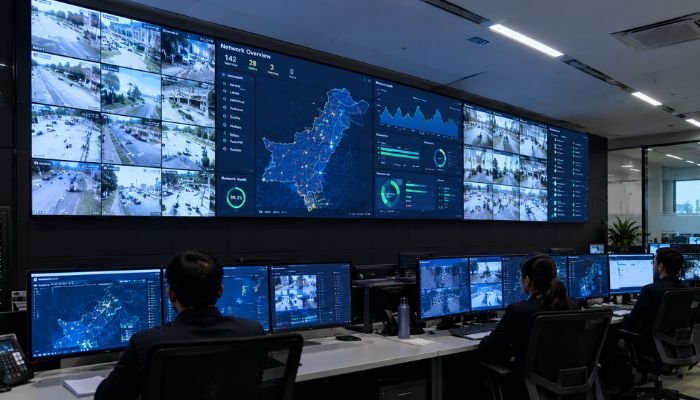
In a bank’s Security Operations Center in Karachi, a telecom NOC in Lahore, or a national security command room in Islamabad, the display is not a tool for presentations. It is the nerve center. It runs every hour of every day. Analysts are watching it at 3 AM. Dozens of live feeds, dashboards, and alert panels are simultaneously active. And a single hardware failure is not an inconvenience — it is an operational emergency.
This is why SOC and NOC video walls are a completely different engineering discipline from a boardroom display or an auditorium screen. This guide covers exactly what separates a mission-critical monitoring wall from a commercial display — and how Smart One Technologies engineers and delivers them across Pakistan.
What Makes a SOC / NOC Video Wall Different From Any Other Display?
Most people assume a larger, higher-resolution screen is all a control room needs. That misses about 80% of what actually matters. Here is what a true mission-critical display requires:
- Continuous 24/7/365 Operation — Without Burn-In
A commercial display is rated for 12 to 16 hours of daily use. An SOC or NOC wall runs non-stop — 8,760 hours a year. That means standard consumer or commercial panels develop burn-in within months, as static dashboard elements permanently ghost onto the screen.
Ultra-fine pitch LED panels (P0.9 to P1.5) used in SOC/NOC environments are rated for 100,000+ hours of continuous operation. Unlike LCD or OLED, LED SMD technology has no burn-in mechanism — each pixel is independently driven, and the display degrades uniformly over its lifespan rather than developing ghost images.
- Sub-P1.5 Pixel Pitch — Because Operators Read Code and Data, Not Headlines
An auditorium screen shows slides. A control room screen shows alert codes, IP addresses, network topology maps, CCTV feeds, financial dashboards, and telemetry data — often simultaneously, across dozens of windows. Text is small. Detail matters at arms length.
At P0.9 to P1.5 pixel pitch, a 3×2 metre video wall renders a native resolution comparable to a 4K display at a comfortable operator viewing distance of 2 to 4 metres. Every digit in an IP address is legible. Every colour in an alert hierarchy is distinct. A P2.5 panel — perfectly adequate for an auditorium — is simply not sharp enough for a control room operator seated 2 metres away.
- Optical Ergonomics — Eight-Hour Shifts, Zero Eye Strain
SOC and NOC analysts work long shifts — often 8 to 12 hours — staring at the same wall. A standard high-glare display surface causes eye fatigue within hours. Blue light-heavy spectra disrupt circadian rhythm for analysts on night shifts.
Anti-blue light filtering and matte anti-reflective coatings are not optional extras in a mission-critical monitoring environment. They are engineering requirements. SOT specifies panels with calibrated colour temperature, anti-glare matte front surfaces, and adjustable low-brightness night modes that reduce eye strain across extended shifts without sacrificing readability.
24/7 Mission-Critical SOC/NOC Video Wall Architecture
This table shows exactly what separates a properly specified command center display from a commercial video wall:
| Engineering Mandate | Commercial Video Wall | SOT Mission-Critical SOC/NOC Display |
| Daily Operating Duty Cycle | 12 to 16 Hours / Day | True 24/7/365 Continuous
Non-Stop Operation |
| Pixel Pitch & Resolution | P2.0 to P3.0 Standard | P0.9 to P1.5 Ultra-Fine Pitch
(High-density telemetry & code legibility) |
| Power & Signal Redundancy | Single Line
(Single Point of Failure) |
Hot-Swappable Dual Power Supplies
& Dual Receiving Loop Backup |
| Operator Optical Ergonomics | Standard Glare Surface | Anti-Blue Light & Matte
Anti-Reflective Coating (Zero eye strain) |
| Multi-Dashboard Matrixing | Basic Input Switching | Novastar / HikCentral IP Matrix
(16+ concurrent windows) |
Every row in this table represents a real failure mode that SOT has seen in commercial displays incorrectly specified for control room environments. The mission-critical specification is not a premium upsell — it is what keeps the wall operational when it matters most.
Redundancy Architecture — Why Single Points of Failure Are Unacceptable
In a standard commercial installation, one power supply failure or one controller card fault takes the screen down. In an SOC or NOC, that is a critical incident. Mission-critical video wall architecture eliminates every single point of failure:
Dual Hot-Swappable Power Supplies
Every cabinet in an SOT mission-critical installation carries dual independent power supplies. If one fails, the secondary takes over instantaneously — zero visible interruption, no reboot, no signal loss. The failed unit can be physically swapped without powering down the display. This is the same architecture used in enterprise server rooms and is an absolute requirement for any SOC or NOC environment.
Dual Receiving Card Failover Loop
The signal path from the video processor to the LED cabinets runs through a dual receiving card loop. If the primary card fails, the backup card picks up the signal within milliseconds. The operator watching the wall sees nothing — the feed continues uninterrupted. SOT designs the loop topology so that no single card failure can black out more than one isolated cabinet — and even that scenario triggers automatic switchover.
Redundant Signal Sources
Beyond the display hardware, SOT’s command center architecture plans for redundant signal inputs — a backup sending unit that mirrors the primary, and fiber-optic cable runs with redundant paths between the control desk and the wall. For facilities that cannot tolerate any signal path disruption, SOT integrates UPS-backed signal distribution that bridges grid failures and generator startup delays without a frame of video loss.
Multi-Dashboard Matrixing — 16+ Concurrent Windows on One Wall
A SOC video wall is not a single-source display. At any moment it might show:
- Live CCTV feeds from 12 locations simultaneously
- A network topology map with real-time alert overlays
- Financial transaction dashboards for fraud monitoring
- An active incident response timeline
- A weather or situational awareness feed
- Team communication and escalation panels
Novastar and HikCentral distributed IP matrix systems allow SOT to configure any number of independent windows — each with its own source, resolution, and refresh rate — positioned anywhere on the wall canvas. An operator can drag a window larger, pin an alert feed to a dedicated section, or trigger a full-wall emergency view with a single command.
For NOC environments in Pakistan’s telecom sector, SOT integrates the matrix with existing NMS (Network Management System) platforms so that automated alerts can push specific feeds to prominent positions on the wall without operator intervention. The wall becomes an active participant in the operations workflow, not just a passive display.
Choosing the Right Pixel Pitch for Your SOC or NOC in Pakistan
Pixel pitch selection in a control room is driven by one factor above all others: operator viewing distance. Here is the practical guide:
- 9 to P1.2 — for control rooms where operators sit 1.5 to 2.5 metres from the wall. Dense telemetry, small-font data, and high-detail CCTV feeds. Used in Tier-1 financial SOCs and national security environments.
- 5 to P1.8 — for NOC environments where operators sit 2.5 to 4 metres back. Still delivers sharp data legibility and wide-canvas coverage. The most common specification for corporate NOCs and large control rooms in Pakistan.
- 0 to P2.5 — for large-format command center overview walls where the primary use is situational awareness rather than data-dense readability. Operators and decision-makers stand back 4 to 6 metres to view the overall operational picture.
SOT conducts a control room geometry survey before recommending any specification — measuring operator positions, ambient light levels, cabinet count, and structural constraints. A pixel pitch chosen from a brochure without a site survey is a guess. A site survey turns it into an engineering decision.
SOC and NOC Video Wall Applications Across Pakistan
Banking & Financial Security Operations Centers
Pakistan’s major banks operate 24/7 SOCs monitoring fraud alerts, ATM networks, branch security feeds, and cyber threat dashboards. SOC video walls in Karachi and Lahore’s banking sector require P1.2 to P1.5 panels with multi-window matrixing and complete redundancy — a bank cannot afford a monitoring blackout. SOT has delivered SOC installations for financial institutions where uptime SLAs are contractually defined.
Telecom Network Operations Centers
Pakistan’s telecom operators — managing millions of subscribers across national networks — run NOCs where engineers monitor routing health, tower status, traffic loads, and incident queues simultaneously. NOC LED displays in Lahore and Islamabad for telecom operators need NMS integration, alarm-driven window management, and pixel pitches that make network topology maps readable across a large team. SOT delivers this as a complete integration, not just a hardware drop.
Government & Defence Command Centers
Government institutions, law enforcement, and defence facilities across Pakistan require mission-critical monitoring walls with security-compliant installation, classified signal routing, and certified installation teams. SOT’s completed project at 83 Signals Battalion, Malir Cantt demonstrates the company’s capability and clearance for sensitive defence installations. The Sindh Building Control Authority project demonstrates delivery for government regulatory operations.
Smart City & Infrastructure Control Rooms
As Pakistan develops smart city infrastructure — traffic monitoring, utility management, emergency response coordination — the control rooms at the heart of these systems need 24/7 monitoring video walls capable of integrating dozens of live data feeds. SOT’s experience with both Hikvision’s HikCentral platform and Novastar processing means these integrations are handled natively, not retrofitted.
Pre-Specification Checklist — SOC/NOC Video Wall Pakistan
Pre-Specification Checklist — SOC/NOC Video Wall Pakistan
|
Frequently Asked Questions
Q: What pixel pitch is best for a Security Operations Center (SOC) video wall in Pakistan?
A: For SOC environments where operators sit 1.5 to 3 metres from the wall, P0.9 to P1.5 ultra-fine pitch is the correct specification. This pitch delivers sufficient pixel density for data-dense dashboards, CCTV feeds, and alert code legibility. Smart One Technologies conducts a geometry survey before recommending a final specification.
Q: Why can’t a standard commercial video wall be used in an NOC?
A: Commercial video walls are rated for 12 to 16 hours of daily operation. An NOC runs 24/7/365 — roughly 8,760 hours per year. Standard panels develop burn-in from static dashboard elements and have single power supplies that represent a critical single point of failure. Mission-critical NOC panels use LED SMD technology rated for 100,000+ hours with dual redundant power and signal architecture.
Q: What is multi-dashboard matrixing and why does an SOC need it?
A: Multi-dashboard matrixing means running 16 or more independent video windows simultaneously on one display wall — each with its own source, resolution, and layout. An SOC simultaneously displays CCTV feeds, network dashboards, alert panels, and communication tools. Novastar and HikCentral IP matrix systems, which Smart One Technologies integrates, allow operators to manage window layouts dynamically and trigger automated alert-driven display changes.
Q: Has Smart One Technologies completed SOC or NOC installations in Pakistan?
A: Yes. SOT’s completed landmark projects include the Sindh Building Control Authority (SBCA) full SOC command center video wall in Karachi, and a mission-critical NOC monitoring wall for 83 Signals Battalion at Malir Cantt, Karachi — a Pakistan Army signals infrastructure installation with redundant power architecture and secure signal routing.
Q: What is the difference between a NOC LED display and a regular office display?
A: A NOC LED display operates continuously, carries redundant power and signal paths, uses ultra-fine pitch panels for data legibility at close range, has anti-glare and anti-blue light treatment for operator health during long shifts, and integrates with network management systems for automated alert-driven display control. A regular office display does none of these things.
Q: Does SOT provide security-cleared installation teams for government SOC projects?
A: Yes. Smart One Technologies has completed installations at government and defence facilities requiring security-compliant installation teams and classified signal routing, including the 83 Signals Battalion project at Malir Cantt. Clearance requirements and classification protocols are confirmed during the project scoping phase.
Final Word
A SOC or NOC video wall is not a display purchase. It is an infrastructure decision. The wrong specification — a commercial panel running 24/7, a single power supply, basic input switching — will fail, and it will fail at the worst possible moment.
The right specification — ultra-fine pitch LED, redundant power and signal architecture, multi-window matrix processing, operator ergonomic engineering — runs continuously for years without incident and becomes an integral part of your operational capability.
Smart One Technologies has delivered that specification for Pakistan’s banking sector, telecom operators, government institutions, and defence facilities. The starting point is always a site survey — because a mission-critical wall is engineered for your room, your operators, and your data sources. Not picked from a catalogue.
| Plan Your SOC / NOC Video Wall With SOT
Share your room dimensions, operator count, and feed sources — Smart One Technologies will specify the right pixel pitch, redundancy architecture, and processing system for your mission-critical environment. 📞 sot.com.pk/contact/ | WhatsApp Available www.sot.com.pk | 15+ Years | 500+ Projects | Hikvision & Unilumin Authorised Partner |

0 Comments on “SOC & NOC Monitoring LED Video Walls in Pakistan: 24/7 Mission-Critical Display Guide”