
|
TL;DR — Quick Answer A digital SMD video wall display is a large-format screen built from multiple LED cabinets tiled seamlessly together, used across Pakistan in retail, government, education, defense, hospitality, and sports venues to deliver sharp, bright visuals at a scale a single panel can’t match. Indoor installations typically use a fine pixel pitch (P1.8–P3) for close-range clarity, while outdoor displays use a coarser pitch (P4–P8) paired with high brightness and IP65 weatherproofing for daylight visibility. Businesses and institutions from Lahore to Islamabad to Sargodha are adopting these displays for everything from advertising to institutional briefings. Smart One Technologies designs and installs digital SMD video wall displays across Pakistan, matching pixel pitch, brightness, and structural engineering to each site’s actual requirements. |
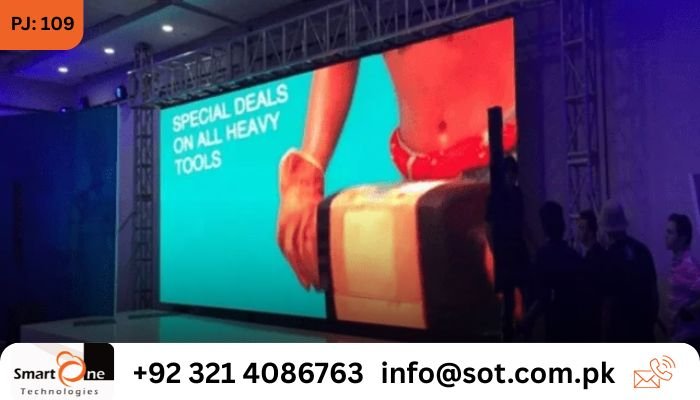
From a mall lobby in Karachi to a government briefing room in Islamabad to a defense facility in Sargodha, digital SMD video wall display technology has become the go-to solution wherever a business or institution needs visuals big enough, sharp enough, and bright enough to command real attention. Unlike a single large-format TV, a video wall is built from multiple LED cabinets tiled together, letting it scale to almost any size — from a modest indoor briefing screen to a 200 square meter outdoor installation — while maintaining sharp, seamless image quality across the entire surface.
This guide covers what a digital SMD video wall display actually is, how indoor and outdoor builds differ, where these displays are being adopted across Pakistan, and what technical factors matter most when specifying one for a specific space.
It’s a category that spans a genuinely wide range of scale and purpose — from a modest indoor display in a small office to a 200 square meter outdoor installation at a major facility — which is exactly why treating every project with the same generic specification rarely produces good results.
What Is a Digital SMD Video Wall Display?
A digital SMD video wall display is built from Surface Mounted Device LED modules, tiled together into a single, seamless screen rather than relying on one large panel. Each cabinet contains thousands of tiny red, green, and blue diodes mounted directly onto the module surface, producing sharp images, accurate color, and consistent brightness even at close viewing distances. Because the display is modular, it can be built to almost any custom size or shape — a capability a fixed-size commercial TV or single LED panel simply can’t match.
Why Digital SMD Video Wall Displays Are Growing Across Pakistan
Demand for digital SMD video wall display installations has grown steadily across Pakistan’s major cities and institutions, driven by a shift away from static signage and standard flat-panel displays toward something that can scale to fill a space, run continuously, and update content in real time. Retail and hospitality venues in Lahore and Karachi use video walls to draw attention and drive foot traffic. Government departments and institutions in Islamabad and Lahore rely on them for briefings, presentations, and internal communication. Defense and aviation facilities use large-format outdoor builds for ceremonial broadcasts and public information. Sporting venues use them as central visual points for live coverage and event branding.
Indoor vs Outdoor Digital SMD Video Wall Displays
|
Factor |
Indoor Video Wall |
Outdoor Video Wall |
|
Typical Pixel Pitch |
P1.8 – P3 |
P4 – P8 (or larger for very long viewing distances) |
|
Brightness |
800 – 1,500 nits |
5,000 – 10,000+ nits |
|
Weatherproofing |
Not required (controlled environment) |
IP65 or higher (dust and water resistant) |
|
Typical Use |
Briefing rooms, retail interiors, control rooms |
Storefronts, highways, stadiums, open grounds |
|
Viewing Distance |
Close range, often under 5 meters |
5 meters and beyond |
Choosing between an indoor and outdoor digital SMD video wall display isn’t just a location decision — it changes the pixel pitch, brightness, and cabinet construction needed to perform correctly. An outdoor-rated display used indoors is often unnecessarily expensive for the resolution actually needed at close range, while an indoor panel installed outdoors would fail quickly against direct sunlight and weather exposure.
Key Applications Across Industries
- Retail and hospitality: Storefront advertising, in-mall video walls, and café or restaurant displays running rotating promotions and menus.
- Government and institutional: Briefing rooms, control centers, and public information displays across departments and agencies.
- Education: Indoor video walls in departmental offices and lecture facilities supporting presentations and digital communication.
- Defense and aviation: Large-format outdoor installations at bases and aviation complexes for ceremonial broadcasts and coordinated visual communication.
- Sports and events: Central visual displays at racecourses, stadiums, and event venues serving as a shared focal point for large audiences.
Technical Factors That Matter
Pixel Pitch
The distance between individual LED pixels determines minimum comfortable viewing distance. A finer pitch suits close-range indoor viewing, while a coarser pitch is more cost-effective for large outdoor displays viewed from further away.
Brightness
Indoor displays need enough brightness for consistent, comfortable viewing under artificial lighting, while outdoor displays need significantly higher output to remain visible against direct sunlight.
Weatherproofing
Outdoor installations require an IP65-rated cabinet at minimum, with sealed cabling and drainage to withstand rain, dust, and heat over years of continuous exposure.
Seamless Tiling and Calibration
Individual cabinets need precise alignment and full-surface calibration after assembly to ensure uniform brightness and color across the entire video wall, rather than visible seams between panels.
Control Systems
The sending and receiving cards, along with the content management software, determine how easily a video wall’s content can be scheduled, updated remotely, and kept running reliably day to day.
Common Mistakes to Avoid When Specifying a Video Wall
- Choosing pixel pitch without measuring real viewing distance: Leads to overpaying for resolution nobody will notice, or a blurry image for the actual audience.
- Using an indoor panel outdoors, or vice versa: Indoor panels lack the weatherproofing to survive outdoor exposure, while outdoor panels are often unnecessarily expensive and less optimized for close indoor viewing.
- Underestimating structural requirements at scale: Larger video walls need proper wind-load and weight calculations, not a mounting approach borrowed from a small display.
- Skipping full-surface calibration: Individual panels calibrated separately, rather than as one unified system, can result in visible brightness or color inconsistencies across the wall.
- Choosing a supplier without local after-sales support: A video wall running continuous daily hours needs prompt access to maintenance and replacement parts, not a vendor who disappears after installation.
The Growing Role of Content Management in Video Wall Performance
A digital SMD video wall display is only as effective as the content running on it and how easily that content can be managed. Modern installations increasingly rely on remote content management systems that let operators update schedules, swap promotional material, or push live broadcasts from a browser or app, without needing a technician on-site for routine changes. For institutions managing multiple displays across different departments or locations, centralized content management also means consistent messaging can be pushed across every connected screen simultaneously, rather than updating each one individually.
This shift toward centralized, remotely managed content has become almost as important as the display hardware itself, particularly for organizations running video walls across multiple sites where manual, on-site updates simply aren’t practical at scale.
Choosing the Right Digital SMD Video Wall Display for Your Space
Specifying a digital SMD video wall display correctly starts with the same basic questions regardless of industry: how far away will the audience actually be, is the installation indoor or outdoor, and how will content be managed day to day? A retail storefront and a government briefing room have completely different requirements even though both might use similar SMD technology — matching the specification to the actual site, rather than applying a generic package, is what determines whether the final installation performs well.
Why Smart One Technologies Is a Trusted Digital SMD Video Wall Display Provider
Founded in 2005, Smart One Technologies has built a documented project history spanning multiple sectors and cities across Pakistan, from retail and hospitality installations in Lahore to institutional video walls in Islamabad and large-format defense-sector displays. This range reflects a site-assessment-first process applied consistently regardless of scale or industry, rather than a single template applied everywhere.
Buyers can explore the full indoor and outdoor SMD screen range, including Hikvision Indoor SMD Screen and Hikvision Outdoor SMD Screen options, or review completed installations on the Our Projects page.
Institutions and businesses can learn more about the company’s background on the About page, or reach out through the Contact page to discuss a project.
Maintenance and Long-Term Reliability
A digital SMD video wall display running long daily hours, whether indoors or outdoors, needs periodic maintenance to keep performing at its rated level — dust filter cleaning, firmware updates, and prompt response for any module-level faults. A support plan covering these basics is what keeps a video wall looking as sharp in year five as it did on installation day.
Frequently Asked Questions
What is the difference between a digital SMD video wall display and a regular LED TV?
A video wall is built from multiple LED cabinets tiled together, allowing it to scale to custom sizes far beyond a fixed-size commercial TV, while typically offering brighter output and more durable construction for continuous daily use.
What pixel pitch is best for an indoor digital SMD video wall display?
For close-range viewing in briefing rooms or retail interiors, P1.8 to P3 pixel pitch is generally recommended, offering sharp detail at typical indoor viewing distances.
Can a digital SMD video wall display be used outdoors in Pakistan’s climate?
Yes, provided it’s specifically rated for outdoor use, with an IP65 or higher weatherproof cabinet and high brightness suited to direct sunlight, dust, and monsoon exposure.
How long does a digital SMD video wall display typically last?
With quality components and proper installation, a well-maintained video wall generally performs reliably for 8 to 10 years before any significant brightness degradation.
Which industries in Pakistan use digital SMD video wall displays the most?
Retail, hospitality, government and institutional facilities, education, defense and aviation, and sports and event venues are among the sectors most actively adopting video wall displays across the country.
Do digital SMD video wall displays require special content management software?
Most modern installations use a remote content management system, allowing operators to update schedules and content from a browser or app without needing an on-site technician for routine changes, particularly useful for organizations managing multiple displays.
Final Thoughts
A digital SMD video wall display gives businesses and institutions across Pakistan a way to communicate at a scale static signage or a single flat panel simply can’t match. Whether the goal is retail advertising, institutional briefing, or large-format public communication, getting the pixel pitch, brightness, and weatherproofing right for the specific site is what separates a display that performs for years from one that disappoints shortly after installation.
|
Planning a Digital SMD Video Wall Display? Smart One Technologies designs and installs indoor and outdoor SMD video wall displays across Pakistan. Get a free consultation and quote today. 📞 +92 321 408 6763 | ✉ sales@sot.com.pk | www.sot.com.pk |

0 Comments on “Digital SMD Video Wall Display in Pakistan”