
| QUICK ANSWER
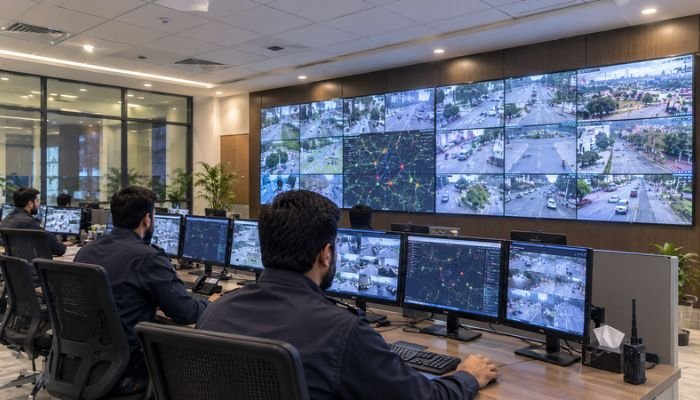
A command center LED video wall in Pakistan serves as a mission-critical visual matrix for municipal surveillance, emergency dispatch, and Safe City traffic monitoring. Smart One Technologies engineers seamless ultra-fine-pitch displays (P0.9 to P1.8) featuring dual power and signal redundancy, 100,000-hour operational lifespans, and multi-window IP video decoding across Lahore, Karachi, and Islamabad. |
Control rooms no longer look like walls of separate monitors. Municipal authorities, Safe City operators and emergency dispatch teams are consolidating hundreds of camera feeds, GIS maps and dashboards onto one seamless canvas. If you are planning a command center video wall in Pakistan, this guide explains why fine-pitch LED has become the preferred technology, how it compares with bezel-based LCD walls, and what a reliable 24/7 installation must include.
What a Command Center Video Wall Actually Does
A command center video wall is the shared visual surface of a control room. Operators work at their own consoles, but the wall gives the whole team one common operating picture: live CCTV, traffic flow, incident maps, alarms and status dashboards. In municipal and Safe City environments it typically supports:
- Live surveillance feeds from city cameras, shown in many windows at once
- Traffic and incident monitoring on GIS maps
- Emergency dispatch coordination and escalation
- Utility, sanitation and public-service dashboards for municipal management
Because supervisors read these displays for hours at a time, image continuity, uptime and legibility matter more than headline brightness.
Commercial LCD Bezel Walls vs SOT Fine-Pitch LED Command Walls
Tiled LCD panels have long been the default for control rooms. Fine-pitch LED changes the three things operators notice most.
| Feature Metric | LCD Bezel Tiled Wall | SOT Seamless Fine-Pitch LED Wall |
| Visual Grid Lines | 1.8mm–3.5mm bezels splitting CCTV feeds | 100% Seamless Zero-Bezel (Zero map obstruction) |
| Duty Cycle & Burn-in | Risk of static phosphor/LCD burn-in | 24/7/365 Continuous Duty (Zero image retention) |
| Hardware Redundancy | Single power supply per display unit | Dual Hot-Swappable Power Supplies & Signal Loop |
Bezels. Even a thin bezel cuts across faces, number plates and map symbols that land on a seam. A seamless LED canvas lets a map or camera feed span the full wall without interruption.
Burn-in. Map backgrounds, window frames and dashboards stay on screen all day. Tiled LCD walls carry a risk of image retention from this static content, while LED modules are built for continuous duty.
Redundancy. When each LCD unit has a single power supply, one failure takes a tile offline. Dual hot-swappable power supplies and a signal loop keep the wall running while a part is replaced.
Choosing Pixel Pitch for a Control Room: P0.9 to P1.8
SOT supplies ultra-fine-pitch LED from P0.9 to P1.8. Pixel pitch is the distance in millimetres between pixel centres. A smaller pitch means higher pixel density and a closer comfortable viewing distance. For control rooms the choice usually follows where people sit and stand:
- 9 to P1.2: walls next to operator consoles, where supervisors sit close and read small text, license plates and map labels.
- 2 to P1.5: a balanced choice for mid-size control rooms that mix CCTV, maps and dashboards.
- 5 to P1.8: larger observation galleries and briefing areas, where the viewing distance is greater.
The final decision is confirmed during a site survey, because room depth, console layout and content type all change the answer.
Built for 24/7/365 Operation
A control room cannot schedule downtime, so reliability has to be designed into the wall from the start.
- Dual power redundancy: if one supply fails, the second keeps the wall lit.
- Signal redundancy: a signal loop gives video a backup path if one cable or sending card fails.
- Hot-swappable components: power supplies can be replaced without shutting the wall down.
- 100,000-hour operational lifespan: a nominal rating that equals roughly 11 years of continuous operation (100,000 hours divided by 8,760 hours in a year).
- Zero image retention: static layouts can stay on screen around the clock without ghosting.
Power quality also matters in Pakistan. A command center should be backed by UPS and generator changeover so a grid interruption never blanks the wall.
Lifecycle planning is just as important as day-one performance. A good project includes a spares kit for critical parts, a documented maintenance schedule and clear escalation contacts, so a faulty module or power unit is replaced quickly instead of becoming a long outage. Regular calibration also keeps brightness and colour uniform across the wall as it ages, which helps operators read maps and camera feeds consistently from one shift to the next.
Multi-Window IP Video Decoding and Control
A video wall is only as useful as the controller behind it. Safe City rooms pull streams from large numbers of IP cameras, so the wall needs decoding and layout software that can:
- Decode and display many IP streams in resizable windows
- Save and recall layouts for situations such as rush hour, an emergency or a public event
- Combine video with maps, dashboards and web applications on the same canvas
- Let operators control the wall from their own consoles
SOT integrates the wall with your existing video management system and cameras, including Hikvision environments, so teams are not forced to replace infrastructure that already works.
Where Command Center Video Walls Are Used in Pakistan
Demand is strongest where many people must make fast decisions from the same information:
- Safe City and traffic control: monitoring junction cameras, congestion maps and incident response from a single room.
- Municipal operations: tracking sanitation fleets, water and utility assets, and citizen-complaint dashboards.
- Emergency dispatch: coordinating ambulance, fire and police response with live maps and camera feeds.
- Network and security operations: watching infrastructure health, alarms and perimeter cameras around the clock.
Each of these environments shares the same needs: continuous operation, a clear view of fine detail and no single point of failure.
How SOT Delivers a Command Center Video Wall in Pakistan
Every project follows a structured turnkey process:
- Requirements and site survey. We record room size, sightlines, ambient light, power and cable routes.
- Layout and ergonomics. Console positions and viewing angles are planned so every operator can see the wall comfortably.
- Wall specification. We select pixel pitch, wall size and the level of redundancy required.
- Power, cooling and cabling. UPS backup, air conditioning and structured cabling are designed before delivery.
- Installation, integration and calibration. The wall is mounted, connected to your video management system and calibrated for uniform brightness and colour.
- Training and support. Operators and technicians are trained, and service support continues after handover.
Control Room Planning Checklist
A good display cannot compensate for a poorly planned room. Before specifying the wall, confirm these points:
- Viewing distance and sightlines: measure from the closest and farthest operator positions to the wall.
- Ambient light: control windows and room lighting so the wall stays readable without glare on operator screens.
- Cooling: LED walls and processing equipment generate heat, so plan air conditioning for the full 24/7 load.
- Power: provide separate power feeds for the two redundant supplies, with UPS and generator backup.
- Service access: leave space for technicians to reach modules and power units without interrupting operators.
- Future growth: allow for extra camera feeds and a larger wall later so the room does not need rebuilding.
Why Smart One Technologies
Smart One Technologies (SOT) is a Tier-1 systems integrator and authorized distributor for LAMPRO, Hikvision and Unilumin commercial displays.
- 15+ years of systems integration experience.
- 500+ completed mission-critical enterprise installations across Lahore, Karachi, Rawalpindi and Islamabad.
- One accountable team for survey, supply, installation, integration and support.
For boardroom-scale displays, see our guide to LAMPRO fine-pitch LED video wall modules.
Frequently Asked Questions
What is a command center video wall?
It is a large shared display, built from LED or LCD tiles, that shows live video, maps and data to a control room team so every operator sees the same real-time picture.
Why choose LED over LCD for a Safe City control room?
LED walls are seamless, built for continuous duty and can include dual power and signal redundancy. Tiled LCD walls have bezels that split feeds and a higher risk of image retention on static content.
Can a video wall run 24/7 without downtime?
Yes, when it is designed for it. Dual hot-swappable power supplies, a signal loop and UPS backup let parts be replaced and power events be absorbed without blanking the wall.
How much does a command center video wall cost in Pakistan?
Cost depends on pixel pitch, wall size, redundancy level, controller and installation scope. SOT prepares a project quotation after reviewing your room dimensions and camera count.
Which cities does SOT serve?
SOT delivers turnkey command center installations across Pakistan, including Lahore, Karachi, Rawalpindi and Islamabad.
Plan Your Control Room Display
Planning a municipal or Safe City control room? Smart One Technologies can size the wall, specify redundancy and manage the complete installation. Contact SOT for a project quotation with your room dimensions and camera count.

0 Comments on “Municipal & Safe City Command Center LED Video Walls in Pakistan: Surveillance & Control Room Display Guide”