
| TL;DR — Quick Answer
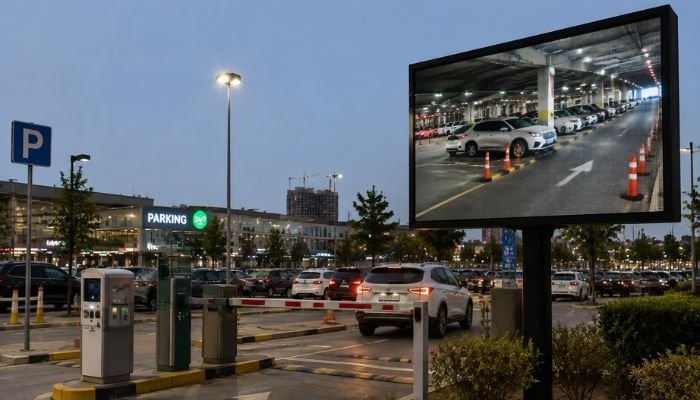
Outdoor SMD screens power the visual layer of a smart parking system, displaying real-time space availability, directional guidance, and pricing by pulling live data directly from sensor and parking management software rather than requiring manual updates. Effective parking displays typically use a mid-range pixel pitch (P4–P6) for entrance boards viewed at moderate distance, high brightness for daylight visibility, and an IP65-rated weatherproof build to handle continuous outdoor exposure. Malls, airports, hospitals, and corporate campuses across Pakistan are increasingly adopting these systems to reduce congestion and improve the driver experience. Smart One Technologies designs and installs outdoor SMD screens integrated with parking management systems, engineered for Pakistan’s climate and backed by local installation and support. |
Anyone who has circled a crowded mall parking lot looking for a free spot understands the problem smart parking systems are designed to solve. The technology behind these systems — sensors, software, and automated gates — only becomes genuinely useful to a driver when it’s paired with a way to actually communicate that information in real time, and that’s exactly where outdoor SMD screens come in. Rather than a driver guessing which level might have space, a well-placed LED display can show live, accurate availability the moment they approach the entrance.
This guide covers how outdoor SMD screens function within a smart parking system, the technical specifications that matter most for this specific use case, real-world applications across Pakistan, and what to look for when planning a similar installation.
What Is a Smart Parking System, and Where Do Outdoor SMD Screens Fit In?
A smart parking system combines sensors, cameras, or software that track vehicle occupancy across a parking facility, feeding that data into a central management platform. On its own, this data is only useful to facility operators unless it’s displayed somewhere drivers can actually see it. This is the role outdoor SMD screens play — translating raw occupancy data into a live, readable display showing available spaces, directional guidance to open sections, or dynamic pricing, positioned at entrances, level access points, and key decision points throughout the facility.
Why Outdoor SMD Screens Are Ideal for Parking Displays
Static painted signs and printed boards simply can’t keep pace with a smart parking system’s real-time data. An outdoor SMD screens solves this by connecting directly to the parking management software, updating automatically as vehicles enter and exit, without any manual intervention. Beyond real-time updates, SMD technology offers the brightness needed to stay legible in direct sunlight, the weatherproofing to handle continuous outdoor exposure, and the flexibility to display multiple types of information — space counts, directional arrows, pricing — on the same screen at different times.
Types of Outdoor SMD Screens Used in Smart Parking
- Entrance availability boards: Positioned at the main entry point, showing total available spaces across the facility before a driver commits to entering.
- Level-by-level directional displays: Placed at ramps or level entries, guiding drivers toward floors or sections with open spaces rather than forcing them to search manually.
- Dynamic pricing boards: Common in commercial and airport parking, displaying rates that adjust automatically based on demand, time of day, or duration.
- Wayfinding and exit guidance screens: Positioned throughout larger facilities to direct drivers toward exits, payment stations, or specific parking zones.
Key Technical Specifications for Parking SMD Screens
| Specification | Recommended Range | Why It Matters |
| Pixel Pitch | P4 – P6 | Matches typical viewing distance from a car approaching an entrance or ramp |
| Brightness | 5,000 – 8,000 nits | Ensures visibility in direct daylight and against reflective vehicle surfaces |
| IP Rating | IP65 or higher | Protects against continuous outdoor exposure, dust, and rain in an uncovered facility |
| Refresh Rate | High refresh rate | Keeps information updating smoothly as occupancy data changes in real time |
| Integration | API or software integration with parking management system | Enables automatic data-driven updates rather than manual content changes |
Pixel pitch selection for an outdoor SMD screens in this context follows the same core principle as any outdoor display: match the pitch to realistic viewing distance. A driver approaching an entrance board is typically 5–10 meters away when the information needs to register, making P4–P6 a practical range for most parking applications without over-specifying for a use case that doesn’t need pixel-level precision.
Benefits of Outdoor SMD Screens in Smart Parking Systems
- Reduced congestion: Drivers head directly to available spaces instead of circling multiple levels searching for one.
- Improved visitor experience: Clear, real-time guidance reduces frustration, particularly at high-traffic venues like malls and airports.
- Revenue optimization: Dynamic pricing displays allow facility operators to adjust rates automatically based on demand.
- Lower operational overhead: Automated data-driven updates eliminate the need for staff to manually change signage or announce availability.
- Enhanced facility image: A modern, digital parking experience reflects well on malls, corporate campuses, and institutional facilities aiming for a more polished visitor experience.
Real-World Applications Across Pakistan
Smart parking displays built around outdoor SMD screens are increasingly relevant across several venue types in Pakistan’s larger cities. Shopping malls use them to reduce entrance congestion during peak weekend hours, airports rely on them to guide passengers efficiently toward available parking during time-sensitive travel, hospitals use them to help patients and visitors find spaces quickly during stressful visits, and corporate campuses with limited on-site parking use them to manage employee and visitor traffic more predictably throughout the day.
This mirrors a broader pattern already established in other automated outdoor SMD display applications, such as fuel station price boards that update automatically from fuel management systems — the same principle of connecting a display directly to a live data source applies just as effectively to parking availability.
How Outdoor SMD Screens Integrate With Parking Management Software
The real value of an outdoor SMD screens in a smart parking context comes from its integration with the underlying management system, not the display hardware alone. Occupancy sensors or cameras feed data into a central software platform, which processes that data and pushes updates to the connected SMD screens through an API or direct software integration. This means the screen’s content changes automatically as real conditions change, without anyone needing to manually update a sign or announce availability over a speaker system.
Installation and Maintenance Considerations
Parking facility installations bring a few specific considerations beyond a typical outdoor SMD screens project:
- Continuous outdoor exposure: Uncovered or semi-covered parking areas expose the display to sun, rain, and dust year-round, making IP65 weatherproofing a baseline requirement rather than an upgrade.
- Vehicle exhaust and dust buildup: Ventilation and filter maintenance need more frequent attention in parking environments than in a typical retail display setting.
- Reliable power and connectivity: A stable network connection between the sensor system and the display is essential for real-time accuracy, making proper cabling and backup power considerations during installation important.
- Viewing angle from vehicles: Mounting height and angle need to account for a driver’s sightline from inside a car, which differs from typical pedestrian-level signage placement.
Why Choose Smart One Technologies for Smart Parking SMD Displays
Deploying outdoor SMD screens for a smart parking system requires more than hardware installation — it requires understanding how to integrate a display with live data feeds and specify a build that survives continuous outdoor exposure. Smart One Technologies, operating in Pakistan since 2005, brings this same data-integration approach to other automated outdoor display projects, including fuel station price boards that update directly from management systems, and applies the same engineering discipline to smart parking installations.
Businesses and institutions can explore the full outdoor SMD screens range, including Hikvision Outdoor SMD Screens options, or review completed installations on the Our Projects page.
Facilities planning a smart parking rollout can reach out through the Contact page, or learn more about the company’s background on the About page.
Cost Considerations for Smart Parking SMD Displays
Budgeting for outdoor SMD screens in a smart parking project involves more than the display hardware alone. The total cost typically includes the SMD panels themselves, the sensor or camera network feeding occupancy data, the parking management software platform, and the integration work connecting the two systems together. Facilities sometimes underestimate this last piece — a display that isn’t properly integrated with live data still needs manual updates, which defeats much of the purpose of installing a smart system in the first place.
For facilities rolling out multiple displays across several entrances and levels, planning the full system as one integrated project, rather than sourcing sensors, software, and screens separately from different vendors, generally leads to a more reliable result and fewer compatibility issues during setup.
Where Smart Parking Displays Are Headed Next
As smart parking adoption grows across Pakistan’s larger commercial and institutional facilities, outdoor SMD screens are increasingly being paired with license plate recognition, mobile app integration for pre-booking specific spaces, and automated payment displays that show a driver’s outstanding balance as they approach an exit gate. These additions build directly on the same display infrastructure already in place for basic availability signage, meaning facilities investing in a well-specified SMD screens system now are generally better positioned to add these capabilities later without replacing the underlying hardware.
Frequently Asked Questions
What pixel pitch is best for parking availability displays?
P4 to P6 pixel pitch is generally the right range for parking entrance and level-guidance displays, matching the typical 5–10 meter viewing distance of a driver approaching in a vehicle.
How does an outdoor SMD screens get real-time parking data?
The display connects to the facility’s parking management software through an API or direct integration, which pushes live occupancy data from sensors or cameras to the screen automatically as conditions change.
Do parking SMD screens need special weatherproofing?
Yes. Since most parking facilities are partially or fully uncovered, an IP65-rated cabinet is generally the minimum standard to handle continuous sun, rain, and dust exposure reliably.
Can one outdoor SMD screens display multiple types of parking information?
Yes. A single screen can rotate between space availability, directional guidance, and pricing information, depending on how the content management system is configured.
What venues in Pakistan are adopting smart parking SMD displays?
Shopping malls, airports, hospitals, and corporate campuses are among the venue types increasingly adopting outdoor SMD screens for smart parking, driven by the need to reduce congestion and improve visitor experience.
Can smart parking SMD displays be upgraded later with new features?
Generally, yes. A well-specified display system can often be extended with features like license plate recognition or mobile pre-booking integration later, without needing to replace the core SMD screens already installed.
Final Thoughts
An outdoor SMD screens deployment for a smart parking system is really an integration project as much as a display installation — the hardware needs to be weatherproof and bright enough for continuous outdoor use, but its real value comes from being properly connected to the sensors and software driving real-time occupancy data. Getting both halves right, the display specification and the data integration, is what turns a parking facility from a frustrating guessing game into a smooth, guided experience for every driver who pulls in.
| Planning a Smart Parking Display System?
Smart One Technologies designs and installs outdoor SMD screens integrated with parking and facility management systems across Pakistan. Get a free consultation and quote today. 📞 +92 321 408 6763 | ✉ sales@sot.com.pk | www.sot.com.pk |

0 Comments on “Outdoor SMD Screens for Smart Parking Systems A Complete Guide 2026”