| TL;DR — Quick Answer
A Smart Board is an interactive touch display that replaces the chalkboard and projector setup in a classroom, and government schools in Lahore are increasingly eligible for them through provincial digital education initiatives, public-private partnerships, corporate social responsibility (CSR) sponsorships, and NGO-funded classroom upgrade programs. Deployment for a government school typically follows a structured path: needs assessment, funding or sponsorship approval, procurement, installation, and teacher training — usually completed within a few weeks once funding is confirmed. Who’s eligible: public sector schools under provincial education departments, often prioritised through digital literacy and smart classroom programs. Smart One Technologies supports government and NGO-funded Smart Board deployments for schools across Lahore, including bulk installation and training. |
Closing the Digital Divide, One Classroom at a Time
Walk into a well-resourced private school in Lahore today and there’s a good chance the classroom has an interactive touch panel where the chalkboard used to be. Walk into many government schools across the same city, and the chalkboard is often still doing all the work. That gap isn’t about teacher capability — Lahore’s public sector teachers are frequently just as skilled as their private sector counterparts — it’s about access to classroom technology. A Smart Board changes that equation, and increasingly, government schools in Lahore have real, structured paths to get one installed without the school itself bearing the full cost. This article covers who qualifies, what a school actually gains from the upgrade, and how a deployment typically moves from approval to a working classroom.
Whether you’re a headteacher exploring funding routes, an education officer evaluating a district-wide rollout, or an NGO planning a classroom sponsorship, this guide lays out the practical steps involved.
What a Smart Board Brings to a Government Classroom
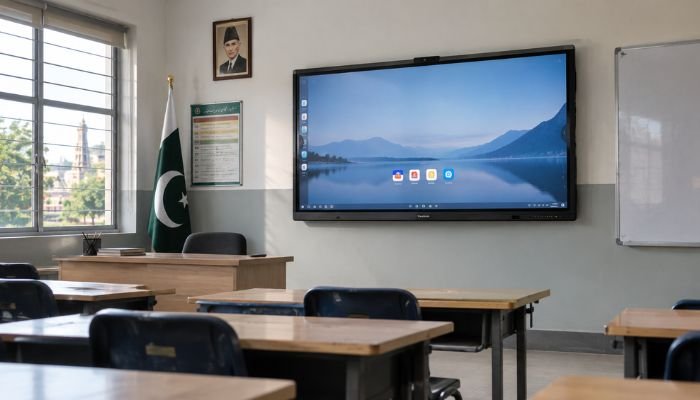
A Smart Board is a large-format interactive touch display that combines a screen, a built-in computer, and teaching software into one unit. Instead of a teacher writing on a chalkboard and separately setting up a projector for multimedia content, a Smart Board handles both in a single device mounted at the front of the classroom. For a government school with limited technology infrastructure, this consolidation matters — one properly installed unit replaces several separate pieces of equipment that would otherwise each need power, maintenance, and space.
Typical Classroom Specifications
| Recommended Screen Size | 65″–75″ for standard classroom sizes of 30–50 students |
| Touch Technology | Infrared or capacitive multi-touch, durable for high student use |
| Resolution | 4K UHD preferred; Full HD acceptable for budget-constrained deployments |
| Operating System | Built-in Android module for standalone use without a separate PC |
| Power Requirements | Standard classroom electrical supply; voltage stabiliser recommended |
| Durability Rating | Commercial-use rated for daily multi-hour classroom operation |
| Best Use Case | Primary and secondary government school classrooms, computer labs |
Who Is Eligible for a Smart Board in a Government School?
Unlike a private purchase, Smart Board access for a government school in Lahore usually runs through one or more structured channels rather than a simple procurement order. Eligibility generally depends on which of these applies to your school:
Provincial Digital Education Initiatives
Punjab’s education department periodically runs smart classroom and digital literacy programs aimed at public sector schools, often prioritising schools based on student enrolment, existing infrastructure gaps, or district-level rollout phases. Schools not currently included in an active phase can typically register interest for future phases through their district education office.
Public-Private Partnerships
Some government schools gain access to Smart Boards through partnerships between the education department and private sector sponsors, where a company funds classroom technology upgrades as part of a broader education improvement initiative.
Corporate Social Responsibility (CSR) Sponsorships
Businesses in Lahore increasingly direct CSR budgets toward education technology, and a government school can often become a sponsorship candidate by presenting a clear needs case to potential corporate partners — sometimes with support from an installation partner who can outline costs and impact clearly.
NGO and Donor-Funded Programs
Local and international NGOs working in education frequently fund classroom technology as part of broader school improvement projects, particularly in underserved areas. Schools already working with an NGO on other initiatives are often well-positioned to request a Smart Board as part of an extended program.
School-Level Budget Allocation
In some cases, a government school with discretionary budget or a supportive parent-teacher association can fund a Smart Board directly, particularly for a pilot classroom before seeking broader funding for additional units.
What Government Schools Actually Gain From a Smart Board
Beyond the obvious upgrade from chalk to touchscreen, the practical benefits for a public sector classroom setting include:
- Reduced teacher preparation burden: Digital lesson content can be reused and updated across terms, rather than teachers redrawing diagrams or rewriting notes on a chalkboard every class.
- Better engagement in large classrooms: Government school classrooms often have higher student counts, and a bright, animated display holds attention more effectively than static chalkboard text from the back rows.
- Access to multimedia learning content: Educational videos, interactive diagrams, and digital textbooks become usable classroom tools rather than resources only available to students with home internet access.
- Support for teacher training programs: A Smart Board also serves as a training tool during in-service teacher development sessions held at the school.
- A visible symbol of investment: For students and parents, a modern classroom display signals that the school is keeping pace with private sector standards, which can support enrolment and community trust.
How a Deployment Actually Moves From Approval to Working Classroom
Step 1: Needs Assessment
A brief assessment identifies which classrooms are prioritised, existing electrical infrastructure, and any structural considerations like wall type or classroom size.
Step 2: Funding or Sponsorship Confirmation
Whether through a provincial program, CSR sponsor, or NGO grant, funding needs to be formally confirmed before procurement begins — this stage often takes longer than the physical installation itself.
Step 3: Procurement and Specification Finalisation
Screen size, resolution, and unit count are finalised based on classroom dimensions and available budget, balancing durability requirements against cost constraints common in public sector procurement.
Step 4: Installation
Units are mounted and wired, typically outside school hours or during a scheduled break to minimise disruption to ongoing classes.
Step 5: Teacher Training
A short, practical training session ensures teachers can use core features confidently — this step is often what determines whether a Smart Board becomes a genuinely used classroom tool or an underused piece of equipment.
Step 6: Follow-Up Support
A basic maintenance and support arrangement, even informal, helps schools resolve minor technical issues quickly rather than letting a fault take a unit out of use for an extended period.
Single-Classroom Pilots vs. School-Wide Rollouts
Most successful government school deployments in Lahore start smaller than people expect. Rather than committing an entire budget to outfitting every classroom at once, a single-classroom pilot lets a school demonstrate impact, train one group of teachers thoroughly, and build a case for expanded funding based on real results rather than projected ones. A school-wide rollout, by contrast, makes more sense once funding is secured through a larger program — a provincial initiative or a substantial NGO grant — where installing multiple units at once creates efficiencies in both cost and training logistics.
Common Obstacles and How Schools Work Around Them
- Unreliable power supply: A voltage stabiliser or basic UPS backup is often included in deployment planning to protect equipment from power fluctuations common in some areas.
- Limited teacher familiarity with technology: Structured, hands-on training — rather than a one-time demo — significantly improves how confidently teachers adopt the new tool.
- Security concerns: Secure mounting and, where needed, lockable classroom storage protect the investment in schools where equipment security is a valid concern.
- Ongoing maintenance capacity: Establishing a simple support point of contact at the time of installation prevents small technical issues from going unresolved for months.
Why Schools and Sponsors Work With Smart One Technologies
Smart One Technologies supports Smart Board deployments for government schools across Lahore, working with education departments, corporate sponsors, and NGOs to move projects from initial needs assessment through to installed, teacher-trained classrooms. Because public sector deployments often involve multiple stakeholders — a funding body, a school administration, and an installation partner — having one team coordinate procurement, installation, and training reduces the coordination burden on school staff who are already managing full teaching loads.
For schools or sponsors exploring this route, it’s worth starting with a simple conversation about classroom count, existing infrastructure, and funding source — from there, a realistic timeline and cost estimate can be put together quickly.
Frequently Asked Questions
Are all government schools in Lahore eligible for a free Smart Board?
Not automatically. Eligibility usually depends on inclusion in a provincial digital education program, a CSR sponsorship, or an NGO-funded initiative, rather than a blanket entitlement for every school.
Can a school apply for a Smart Board directly?
Schools can register interest through their district education office for provincial programs, or approach corporate sponsors and NGOs directly with a clear needs case, often with support from an installation partner.
How long does a typical school deployment take?
Physical installation for a single classroom usually takes a day, but the overall timeline depends heavily on how long funding and procurement approval takes, which can range from a few weeks to a few months.
Do teachers need special training to use a Smart Board?
Basic training is recommended and usually included as part of a proper deployment. Most teachers become comfortable with core features like annotation and multimedia playback within a short, hands-on session.
What happens if a Smart Board breaks down in a government school?
A good deployment plan includes a basic maintenance or support arrangement at installation time, so schools have a clear point of contact for repairs rather than an unresolved fault taking the unit permanently out of use.
Who helps coordinate Smart Board deployments for government schools in Lahore?
Providers such as Smart One Technologies work with education departments, sponsors, and NGOs to manage procurement, installation, and teacher training for public sector school deployments.
Final Thoughts
The gap between a private school classroom and a public one in Lahore doesn’t have to be a technology gap — it’s increasingly a matter of connecting the right school to the right funding channel. A Smart Board, properly deployed with real teacher training and basic ongoing support, does more than modernise a classroom; it gives students in the public sector access to the same interactive learning tools their private school peers already have. For education officers, sponsors, and school administrators exploring this path, the first step is simply understanding which eligibility route fits your specific school — from there, the deployment process itself is well-established and manageable.
| Planning a Smart Board Deployment for a Government School?
Get a free needs assessment and deployment plan from Smart One Technologies for your school, district, or sponsorship program. |
0 Comments on “Smart Board for Government Schools in Lahore: Eligibility, Benefits, and Deployment”