
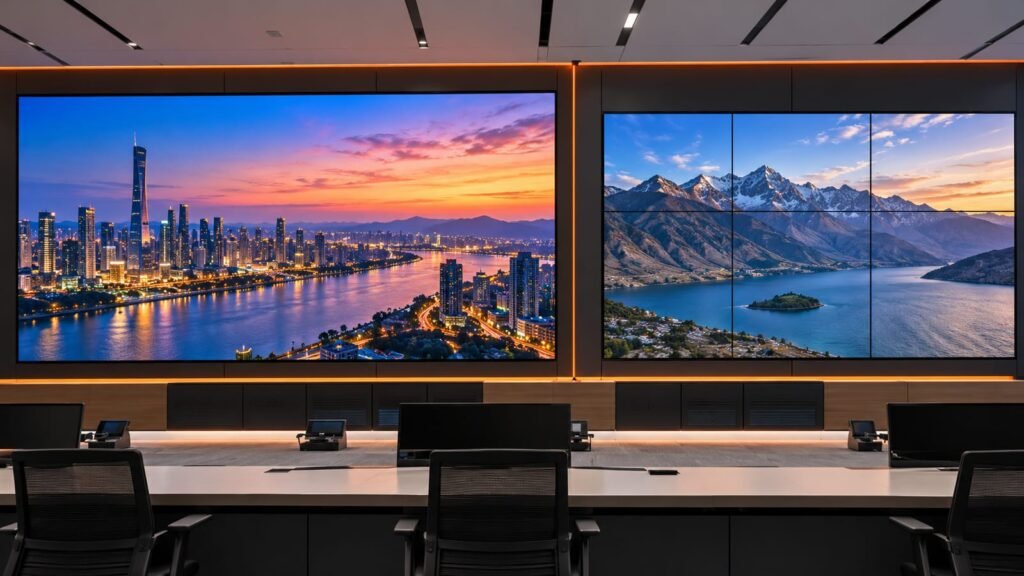
TL;DR — Quick Answer
Choose an SMD LED video wall when your business needs a large, seamless display, flexible screen dimensions, strong brightness, or an installation that may be viewed from different distances. Choose an LCD video wall when close-up detail, fine text, fixed panel layouts, and a controlled indoor environment are the main priorities. Neither technology is automatically better: the right choice depends on viewing distance, content, room lighting, wall size, operating hours, maintenance access, and total project budget.
For many large corporate lobbies, auditoriums, retail feature walls, and command centres, a fine-pitch SMD screen is worth evaluating. For compact control rooms or spaces where operators read detailed text from close range, a professional narrow-bezel LCD wall may be the more practical option.
Introduction
A video wall is often one of the most visible technology investments in a business. It may welcome visitors in a corporate lobby, support presentations in a boardroom, show product campaigns in a retail store, or keep operational information visible in a monitoring centre. The display therefore needs to do more than look impressive on installation day: it must suit the room, content, users, and maintenance arrangements.
When comparing an SMD Screen vs LCD Video Wall, buyers sometimes focus only on screen size or the initial quotation. That can lead to an expensive mismatch. A display that looks excellent from ten metres away may not be ideal for reading small text at one metre. A tiled LCD wall may deliver crisp close-up detail, but its panel borders can interrupt maps, videos, and wide images.
This guide explains the differences in practical terms for businesses in Pakistan. Smart One Technologies works with SMD screen and indoor LED video wall solutions, and the aim here is to help decision-makers ask the right technical questions before selecting a system.
1. What Is an SMD Screen or LED Video Wall?
An SMD screen uses Surface-Mounted Device LED packages. Red, green, and blue LED elements are mounted on a circuit board to create pixels. Many small LED modules are assembled into cabinets, and the cabinets are joined to form a larger display. Because there is no LCD panel frame between neighbouring cabinets, a correctly assembled LED wall presents one continuous image without the regular bezel lines associated with tiled LCD displays.
SMD video walls are modular. The installer can plan the overall width and height around the available wall space, subject to cabinet dimensions, resolution, structural support, and the display processor. Indoor models are available in fine pixel pitches for closer viewing; outdoor models use different brightness, cabinet, and weather-protection specifications.
Smart One Technologies presents indoor SMD video wall options for applications such as boardrooms, corporate lobbies, control rooms, retail interiors, and auditoriums. Explore the company’s [indoor SMD video wall solutions](https://sot.com.pk/product/video-wall/) to review the type of applications and specifications that should be discussed during a project assessment.
2. What Is an LCD Video Wall?
An LCD video wall is created by arranging multiple commercial LCD panels in a grid, such as a 2-by-2, 3-by-3, or larger configuration. Each panel has its own display area and backlight. Special narrow-bezel models reduce the gap between panels, but a physical seam remains where the screens meet.
LCD video walls are commonly used in indoor control rooms, security monitoring centres, transport operations, and other environments where operators view dashboards, maps, camera feeds, and text-heavy information. The panels have fixed native resolutions and sizes, so the total wall layout is determined by the selected panel model and the number of screens.
A professional LCD wall may use a video wall controller or processor to distribute one image across the panels, arrange multiple sources, or create separate viewing zones. Buyers should confirm whether the required functions are built into the displays or need an external controller.
3. SMD Screen vs LCD Video Wall: Key Differences
Comparison Factor | SMD LED Video Wall | LCD Video Wall |
Display construction | LED modules and cabinets form one display surface. | Separate LCD panels are tiled in a grid. |
Visible seams | No LCD-style bezel lines; pixel pitch still affects close viewing. | Narrow but visible panel borders remain. |
Screen dimensions | Modular dimensions can be planned around the space. | Based on fixed panel sizes and grid layouts. |
Close-up text | Depends strongly on pixel pitch and resolution. | Often strong for fine text at close range. |
Brightness | Indoor and outdoor models offer different brightness ranges. | Depends on panel model; generally designed for indoor use. |
Ambient light | High-brightness options suit bright spaces when correctly specified. | Best assessed for controlled indoor lighting and reflections. |
Maintenance | Faulty modules or components may be serviced individually, subject to design. | A faulty panel may need panel-level replacement. |
Shape flexibility | Can support custom aspect ratios and some creative layouts. | Usually limited to flat, rectangular panel grids. |
Typical fit | Large lobbies, auditoriums, retail feature walls, and seamless displays. | Control rooms, monitoring grids, and text-focused indoor walls. |
4. Image Quality: Seamless Display vs Fine Detail
The most obvious visual difference is the seam. On an LCD wall, even a narrow bezel creates lines across the image. Those lines may be acceptable when each panel shows a separate camera feed or dashboard. They can be distracting when one map, presentation, or video stretches across the full wall.
An SMD LED wall avoids those panel borders, which is useful for immersive brand visuals, large presentations, and uninterrupted video. However, seamless construction does not automatically mean every LED wall is sharp at every distance. Pixel pitch—the distance between adjacent pixel centres—determines pixel density. A smaller pitch generally provides more detail per square metre and supports closer viewing, while a larger pitch is usually better suited to longer viewing distances.
For example, a fine-pitch indoor SMD wall may be considered for a boardroom where people sit relatively close. A larger-pitch wall may be appropriate for a spacious lobby where viewers stand farther away. Always assess a sample display at the actual viewing distance and test the type of content your staff will use, including spreadsheets, small labels, maps, and video.
5. Brightness and Suitability for Pakistan’s Environments
Pakistan’s business environments vary widely. A window-facing reception in Lahore, a shaded retail interior in Karachi, a temperature-controlled boardroom in Islamabad, and an outdoor commercial frontage all place different demands on a display.
SMD LED systems are available in indoor and outdoor configurations. Outdoor units are designed with higher brightness and appropriate weather protection, cabinet construction, ventilation, and electrical safeguards. An indoor LED wall should not be treated as an outdoor product simply because it looks bright in a showroom. The required IP rating and operating-temperature range must be checked against the installation location.
LCD video walls are generally intended for indoor installations. They can work very well in controlled lighting, but direct sunlight, reflections, heat, and dust around the installation need to be considered. If the wall is close to windows or exposed to strong ambient light, compare measured brightness and anti-glare properties from the actual model datasheets rather than relying on generic technology claims.
For Pakistan, also plan for stable power, suitable earthing, surge protection, ventilation, and access for technicians. These practical details can have as much impact on long-term reliability as the display technology itself.
6. Which Technology Is Better for Different Business Applications?
Corporate reception and brand walls
An SMD LED video wall is often a strong candidate when the objective is a large, uninterrupted brand canvas. It can display welcome messages, company films, achievements, and visual campaigns without a grid of LCD bezels cutting through the image. The final pixel pitch should match the closest visitor viewing distance.
Boardrooms and conference rooms
Both technologies can work. A compact room used for detailed spreadsheets, video calls, and small text may favour a high-resolution LCD solution or a fine-pitch LED wall. A larger boardroom that needs a wide, seamless image may favour SMD LED. Compare the full installed resolution, not only the diagonal screen size.
Security and network operations centres
LCD walls are commonly considered where operators need crisp text, maps, and multiple independent camera or dashboard windows. SMD LED becomes attractive when a large continuous canvas, custom dimensions, or fewer visible divisions are important. In either case, verify controller features, source switching, redundancy, 24/7 duty rating, and maintenance access.
Retail stores and showrooms
SMD LED is useful for large promotional visuals, product storytelling, and feature walls where image impact matters. LCD panels can be appropriate for smaller information walls, menu boards, or installations where close-up detail and a controlled indoor setting are priorities.
Auditoriums, training spaces, and event venues
An SMD wall can scale to a wide stage or presentation surface and avoid visible panel borders across the main image. LCD may be suitable for smaller fixed installations or separate information screens. The decision should account for audience distance, camera recording, content resolution, and the need to show multiple sources.
7. Cost, Power Consumption, and Total Cost of Ownership
There is no reliable universal rule that an SMD wall always costs more or an LCD wall is always cheaper. The quotation depends on the selected models, screen area, pixel pitch or panel resolution, controller, mounting structure, electrical work, installation complexity, warranty, and local service arrangements.
For SMD LED, finer pixel pitch usually increases the number of LEDs and processing requirements per square metre. For LCD, the number and size of panels, bezel specification, controller, and replacement availability influence the project cost. Ask suppliers to separate hardware, controller, structure, installation, commissioning, warranty, and optional maintenance in the quotation.
Power consumption also varies by model and content. LED power draw changes with brightness and the amount of illuminated content; LCD consumption depends on panel size, backlight, brightness setting, and operating mode. Request typical and maximum power figures from the manufacturer, then estimate usage using the expected daily operating hours. Include cooling and supporting equipment where relevant.
A sound comparison should consider total cost of ownership over the planned service period—not only the purchase price. Include electricity, preventive maintenance, spare parts, downtime risk, warranty terms, and the time needed to service a fault.
8. Maintenance, Repair, and Service Access
SMD LED walls are built from replaceable modules and cabinets, which can make targeted servicing possible. The actual repair method depends on whether the product is front-service or rear-service, how the cabinets are mounted, and whether compatible spare modules and components are available. Calibration may be needed after replacing a module to maintain consistent colour and brightness.
With an LCD wall, service is typically organised around individual panels, power boards, controller connections, and the mounting system. Replacing a panel may require matching the model, brightness, colour characteristics, and bezel alignment of the existing wall.
Before purchase, ask who will provide local technical support, how quickly spare parts can be sourced, whether technicians can access the rear of the wall, and what the warranty excludes. Smart One Technologies highlights site assessment, installation, calibration, and local after-sales support as part of its indoor SMD video wall project approach. Review the company’s [background and services](https://sot.com.pk/about/) and confirm the exact scope in writing for your project.
9. A Practical Buying Checklist for Pakistani Businesses
- Measure the available wall width, height, viewing distance, and access route for equipment.
- List the content types: text, spreadsheets, maps, CCTV feeds, presentations, video, or advertising.
- Identify the closest and farthest viewer positions, not just the room’s average distance.
- Check ambient light, window direction, reflections, ventilation, dust, and temperature.
- For SMD LED, compare pixel pitch, native resolution, brightness, refresh rate, colour consistency, and service method.
- For LCD, compare panel size, native resolution, bezel width, brightness, anti-glare properties, and panel availability.
- Confirm video processor/controller features, input types, source switching, and multi-window needs.
- Request power consumption figures and plan suitable electrical protection and earthing.
- Ask for warranty details, local service arrangements, spare-parts availability, and preventive maintenance options.
- View a demonstration using your own content from the actual or a similar viewing distance.
10. Why Consider Smart One Technologies?
Selecting a video wall is a project-planning decision, not simply a product purchase. The display must match the room, viewing behaviour, content sources, power conditions, and future maintenance plan. Smart One Technologies states that it was established in 2005 and provides IT, presentation media, indoor SMD video wall, and outdoor display solutions in Pakistan.
For an SMD LED project, Smart One Technologies can help assess the site, discuss pixel pitch and brightness, plan cabinet mounting, configure the display system, and coordinate installation and calibration. The company’s indoor video wall information identifies boardrooms, corporate lobbies, control rooms, retail interiors, auditoriums, and institutional facilities as relevant applications.
Explore [Smart One Technologies’ LED video wall solution](https://sot.com.pk/product/video-wall/) or visit the [SOT homepage](https://sot.com.pk/) to discuss the requirements of your business. Ask for a project-specific recommendation rather than choosing a pixel pitch or screen size from a generic package.
Final Verdict
The best choice in the SMD Screen vs LCD Video Wall comparison depends on what the display must do every day. SMD LED is usually the stronger option when the priority is a large seamless image, custom dimensions, high brightness options, or a visually impactful feature wall. LCD is often a practical choice for indoor environments where close-up detail, text clarity, and a tiled multi-panel layout are more important than eliminating every seam.
Before making a decision, compare both technologies at the intended viewing distance, test real business content, and review the complete installed-system quotation. Smart One Technologies can help businesses evaluate indoor SMD video wall requirements and plan a solution around the actual space and use case. A properly specified display is the one that serves your team and customers reliably—not simply the one with the biggest screen.
Frequently Asked Questions
1. What is the main difference between an SMD screen and an LCD video wall?
An SMD screen is assembled from LED modules to create a continuous display surface, while an LCD video wall combines separate LCD panels in a grid. LCD panels retain visible bezel seams; SMD LED does not have those panel borders.
2. Is an SMD LED video wall better than an LCD video wall?
Not in every situation. SMD LED is often better for large seamless displays, custom sizes, and bright environments. LCD can be better for close-up text and detailed monitoring in controlled indoor spaces. The room and content should decide.
3. Which is better for a corporate boardroom in Pakistan?
Both can work. Consider LCD or fine-pitch SMD LED when viewers sit close and need to read detailed content. For a larger boardroom that needs a wide, uninterrupted presentation surface, a fine-pitch SMD wall may be a strong option.
4. Which technology is suitable for a control room or NOC?
LCD video walls are often selected for text-heavy dashboards and multiple independent feeds. SMD LED is worth considering when a seamless large canvas or custom dimensions are important. Controller functions, duty rating, redundancy, and service access matter for both.
5. Does an SMD video wall have visible lines between panels?
It does not have LCD-style bezel lines between cabinets. However, the LED pixel structure can be visible at very close distances, especially with a larger pixel pitch. Choose the pitch according to the closest viewing position.
6. What pixel pitch should I choose for an indoor SMD video wall?
Common indoor options include fine pitches such as P1.2, P1.5, P1.8, P2.5, and P3. The right option depends on viewing distance, content detail, screen size, and budget. A site assessment and sample viewing are recommended.
7. Can an SMD screen be used outdoors in Pakistan?
Yes, if it is an outdoor-rated model designed for the location. Check brightness, IP protection, cabinet construction, operating temperature, ventilation, structural design, and electrical protection. Indoor models should not be installed outdoors without suitable manufacturer approval.
8. Which video wall uses less electricity, SMD LED or LCD?
There is no universal winner. Consumption depends on display model, brightness, content, screen area, and operating hours. Compare manufacturer-rated typical and maximum power figures for the exact proposed systems.
9. Which system is easier to maintain?
Both require planned maintenance. SMD LED modules may be serviced individually depending on the cabinet design and front- or rear-service access. LCD maintenance is generally panel-based. Spare-parts availability and local technical support should be checked before purchase.
10. Where can I get an SMD LED video wall in Pakistan?
Businesses can contact Smart One Technologies to discuss indoor SMD video wall requirements, including boardrooms, lobbies, control rooms, retail interiors, and institutional applications. Visit sot.com.pk or request a site assessment and project-specific quotation.

0 Comments on “SMD Screen vs LCD Video Wall in Pakistan — Which Is Better for Your Business?”