
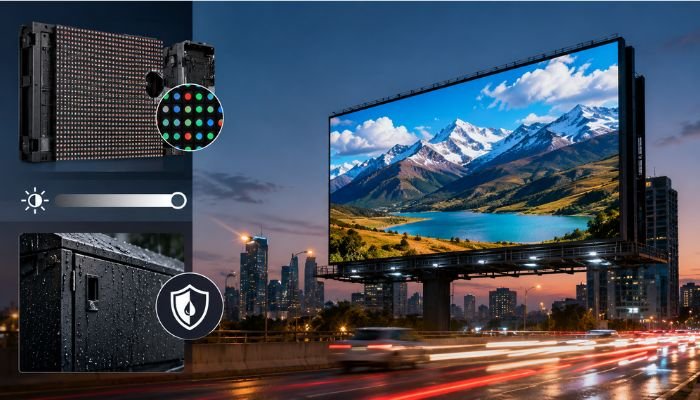
| TL;DR — Quick Answer
• An outdoor digital billboard needs three specs working together: brightness of 5,000–8,000+ nits for daylight readability, a pixel pitch of P6 to P10 for typical roadside viewing distances, and a minimum IP65 rating (front) with IP65/IP66 rear protection for weatherproofing. • Higher nits fight sunlight glare; wider pixel pitch is fine for far-away viewing and cuts cost; higher IP ratings protect against Pakistan’s dust, heat, and monsoon rain. • Smart One Technologies (sot.com.pk) supplies, installs, and maintains outdoor digital billboards engineered for Pakistani weather conditions, from P4 to P10 configurations. |
Why Outdoor Digital Billboard Specifications Actually Matter
Drive down any major road in Lahore, Karachi, or Islamabad today and the skyline looks different than it did five years ago. Static flex banners are steadily being replaced by glowing, animated outdoor digital billboards that change creative every few seconds. But not every billboard performs the same way, and the difference almost always comes down to three technical specifications: brightness, pixel pitch, and IP rating.
If you are planning to invest in an outdoor digital billboard for your business, a commercial plaza, a highway site, or a rental advertising network, understanding these three numbers before you sign a purchase order can save you from years of regret. A screen that looks perfect in an indoor showroom can wash out completely under midday sun, or fail within a single monsoon season, if its specifications were never matched to outdoor conditions in the first place.
This guide breaks down exactly what these specifications mean, how they affect real-world performance, and how to choose the right combination for your location, budget, and viewing distance.
What Is an Outdoor Digital Billboard?
An outdoor digital billboard is a large-format LED display, built using SMD (Surface Mounted Device) technology, that is engineered specifically to operate outside — meaning it must withstand direct sunlight, rain, dust, temperature swings, and continuous operation, typically for 8 to 10 or more years. Unlike an indoor LED wall, an outdoor digital billboard is sealed against moisture, uses higher-brightness LED chips, and is generally built with a wider pixel pitch because viewers see it from a greater distance.
Outdoor digital billboards are used for roadside advertising, building facades, highway hoardings, stadium perimeter boards, fuel station canopies, and commercial plaza signage across Pakistan.
1. Brightness: Measured in Nits, Decided by Sunlight
Brightness is the single most misunderstood specification in outdoor digital billboard shopping. It is measured in nits (candela per square metre), and it determines whether your content is actually visible under direct sunlight — or fades into a dull, unreadable blur by midday.
Why Nits Matter Outdoors
Indoor LED screens typically operate between 600 and 1,200 nits, which is more than enough in a controlled, low-light environment like a retail store or a boardroom. Take that same panel outdoors and it becomes almost invisible in direct sunlight. Outdoor digital billboards need considerably more raw output, plus automatic brightness control that adjusts in real time as ambient light changes through the day.
| Environment | Recommended Brightness (Nits) | Typical Use Case |
| Shaded outdoor / covered area | 3,500 – 4,500 nits | Under-canopy signage, covered walkways |
| Standard outdoor roadside | 5,000 – 6,500 nits | Street-facing billboards, plaza signage |
| Direct sunlight / open highway | 6,500 – 8,000 nits | Highway hoardings, building facades |
| High-glare / reflective surroundings | 8,000+ nits | Waterfront, glass-facade buildings, wide open sky exposure |
Beyond raw nits, look for automatic brightness sensors. A well-engineered outdoor digital billboard should dim itself at dusk and night to avoid glare complaints and unnecessary power draw, then ramp back up automatically as the sun rises — without any manual adjustment.
2. Pixel Pitch: The Number That Decides Image Sharpness and Viewing Distance
Pixel pitch is the distance, in millimetres, between the centre of one LED pixel and the centre of the next. It is written as P followed by a number — P4, P6, P8, P10, and so on. The smaller the number, the tighter the pixels, the sharper the image, and the closer a viewer can stand before individual pixels become visible. The larger the number, the further back the ideal viewing distance, and generally, the lower the cost per square metre.
A Simple Rule of Thumb
A commonly used formula for minimum viewing distance is: pixel pitch (mm) × 3, expressed in metres. So a P8 outdoor digital billboard has a comfortable minimum viewing distance of roughly 24 metres, while a P10 screen is best viewed from about 30 metres or more. This is exactly why highway billboards, viewed from fast-moving traffic dozens of metres away, do not need — and should not pay for — an ultra-fine pixel pitch designed for close-up indoor viewing.
| Pixel Pitch | Approx. Minimum Viewing Distance | Best Suited For |
| P4 – P5 | 12 – 15 metres | Plaza entrances, roadside shops, close pedestrian traffic |
| P6 – P8 | 18 – 24 metres | Commercial billboards, building facades, medium-distance roads |
| P10 | 30 metres + | Highway hoardings, stadium perimeter, large open spaces |
Choosing a finer pixel pitch than your viewing distance requires is not necessarily a mistake — it does deliver a crisper image — but it adds significant cost without a proportional visual benefit if viewers can never get close enough to notice the difference. The smarter approach is to match pixel pitch to the realistic average distance your audience will be standing or driving from.
3. IP Rating: How Well the Billboard Survives Pakistani Weather
IP rating, short for Ingress Protection rating, tells you how well a display is sealed against solid particles (dust, sand) and liquids (rain, humidity, splashing). It is written as IP followed by two digits — for example, IP65. The first digit (0–6) rates protection against dust and solid objects; the second digit (0–9) rates protection against water.
For a country with Pakistan’s climate — intense summer dust storms, heavy monsoon downpours, and coastal humidity in cities like Karachi — IP rating is not a minor spec sheet detail. It is the difference between a billboard that runs reliably for a decade and one that develops moisture damage, corrosion, or panel failure within its first year.
| IP Rating | Dust Protection | Water Protection | Recommended For |
| IP54 | Limited dust protection | Splash resistant | Semi-outdoor, covered areas only |
| IP65 | Fully dust-tight | Protected against low-pressure water jets | Standard outdoor billboards (front cabinet) |
| IP66 | Fully dust-tight | Protected against powerful water jets | High-exposure sites, coastal and monsoon-heavy regions |
| IP67 | Fully dust-tight | Protected against temporary immersion | Flood-prone or extreme-exposure installations |
As a working rule for outdoor digital billboards in Pakistan: the front of the cabinet should be rated at least IP65, and the rear (electronics compartment) should also carry a minimum IP54–IP65 rating. For coastal cities or sites with heavy monsoon exposure, stepping up to IP66 on both front and rear meaningfully reduces the long-term risk of water ingress and premature failure.
How Brightness, Pixel Pitch, and IP Rating Work Together
None of these three specifications should be evaluated in isolation. A billboard with excellent brightness but a poor IP rating will look stunning for a season and then fail the first time it rains heavily. A finely pitched screen with weak brightness will look sharp up close but wash out completely in daylight. The right outdoor digital billboard is the one where all three specifications are matched to the same real-world conditions: your site’s sun exposure, your audience’s viewing distance, and your local weather.
- High-traffic highway sites: prioritise brightness (6,500–8,000 nits) and a wider pixel pitch (P8–P10), paired with IP65/IP66 protection.
- Plaza or shopfront signage: moderate brightness (5,000–6,500 nits), a tighter pixel pitch (P4–P6) for closer viewers, and IP65 minimum.
- Coastal or monsoon-heavy regions: regardless of pitch or brightness, insist on IP66 for both front and rear cabinet protection.
- Building facades and elevated installations: factor in structural mounting and maintenance access alongside the display specs themselves.
Common Mistakes Buyers Make When Choosing Outdoor Digital Billboard Specs
- Buying based on price per panel alone, without checking nits, pixel pitch, or IP rating against the actual installation site.
- Choosing an indoor-rated or semi-outdoor panel for a fully exposed outdoor location to save on upfront cost.
- Ignoring automatic brightness control, resulting in a screen that is either too dim at night or unreadable during the day.
- Selecting an unnecessarily fine pixel pitch for a highway site, inflating cost without any real visual benefit at that distance.
- Skipping professional structural and electrical assessment, which affects long-term durability as much as the panel specs themselves.
Why Businesses Choose Smart One Technologies for Outdoor Digital Billboards
Smart One Technologies (sot.com.pk) has been supplying and installing indoor and outdoor SMD LED display solutions in Pakistan since 2005. For outdoor digital billboard projects specifically, Smart One Technologies handles the complete lifecycle: site assessment, brightness and pixel-pitch selection suited to the exact viewing distance, IP-rated weatherproof cabinet supply, structural mounting, content management software, and after-sales maintenance.
Explore Smart One Technologies’ outdoor SMD video wall range to see pixel pitch options built for outdoor daylight visibility, or read the latest SMD screen technology trends for 2026 to understand where outdoor display technology is heading next.
Businesses looking for a smaller-format alternative to a full billboard — such as pole-mounted street advertising — can also review Smart One Technologies’ LED 4K digital pole streamers, which use the same brightness and IP-rating principles covered in this guide.
For a broader comparison of display brands available in the Pakistani market, Smart One Technologies has also published a complete guide to Hikvision SMD screens, useful reading for buyers comparing indoor and outdoor panel options side by side.
Frequently Asked Questions
What brightness (nits) does an outdoor digital billboard need?
Most outdoor digital billboards need between 5,000 and 8,000 nits to remain clearly visible in direct sunlight, with automatic brightness control to dim the display safely at night.
What is the best pixel pitch for a roadside billboard?
For standard roadside billboards viewed from 20–30 metres, P8 to P10 pixel pitch offers the best balance of image clarity and cost. Closer plaza or shopfront installations can use P4 to P6.
What IP rating should an outdoor LED billboard have?
A minimum of IP65 is recommended for the front cabinet of any outdoor digital billboard. For coastal cities or monsoon-heavy regions, IP66 on both front and rear cabinet is a safer long-term choice.
How long do outdoor digital billboards last?
With correctly matched brightness, pixel pitch, and IP rating, along with regular maintenance, a quality outdoor digital billboard typically operates reliably for 8 to 10 years or more.
Is a higher pixel pitch number better or worse?
A higher pixel pitch number means wider spacing between LEDs, which is better suited to long viewing distances and generally lower in cost — it is not inherently worse, simply designed for a different viewing range than a fine pixel pitch.
Can Smart One Technologies customise an outdoor digital billboard for my site?
Yes. Smart One Technologies conducts a site assessment to recommend the right brightness, pixel pitch, and IP rating combination for each location’s sun exposure, viewing distance, and weather conditions.
Final Thoughts
An outdoor digital billboard is a long-term asset, not a one-time purchase, and its performance over the years depends entirely on getting three specifications right from day one: enough brightness to beat the sun, the correct pixel pitch for how far your audience actually stands, and an IP rating that can survive Pakistan’s dust, heat, and monsoon rain. Get these three right, and an outdoor digital billboard becomes one of the most effective, durable advertising assets a business can own.
| Ready to Install an Outdoor Digital Billboard That Lasts?
Talk to Smart One Technologies for a free site assessment and a brightness, pixel pitch, and IP-rating recommendation tailored to your exact location. → Visit sot.com.pk to get a custom outdoor digital billboard quote |

0 Comments on “Outdoor Digital Billboard Specifications Explained: Brightness, Pixel Pitch & IP Ratings”